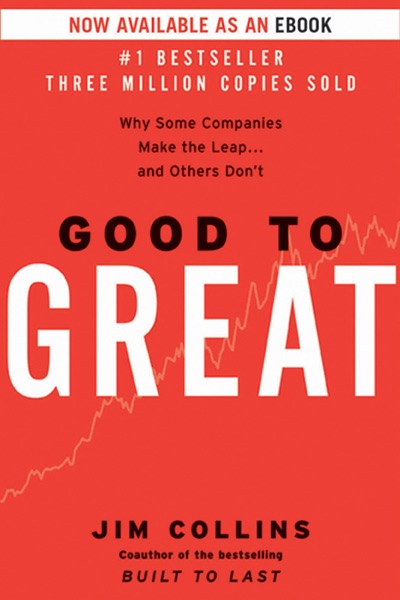
Good to Great
by Jim Collins
📖 About the book
Good to Great by Jim Collins is a seminal management study published in 2001 that examines why some companies make the leap to superior results while others remain merely average. Collins and his research team spent five years analyzing a massive dataset of 1,435 companies to identify the specific factors that distinguish elite performers. The book provides a rigorous, data-driven framework that challenges many conventional myths about corporate leadership, making it a staple for anyone serious about building a high-performance organization.
The core philosophy revolves around the Hedgehog Concept, which encourages firms to focus on what they are passionate about, what they can be the best in the world at, and what drives their economic engine. Collins introduces Level 5 Leadership, where leaders combine personal humility with intense professional will. He also outlines the First Who... Then What principle, emphasizing that getting the right people on board is more critical than the initial strategy. The Flywheel Effect demonstrates how consistent, disciplined effort builds momentum over time until it reaches a breakthrough point of sustained success.
This book is essential reading for CEOs, entrepreneurs, and managers at all levels. Readers gain value by learning to replace "genius with a thousand helpers" with a sustainable Culture of Discipline and a focus on core competencies. Real-world applications include refining hiring practices to ensure cultural fit and simplifying strategic objectives to eliminate distracting "good" opportunities that hinder the pursuit of greatness. By applying these principles, leaders can build resilient organizations that outlast market cycles and deliver exceptional value to all stakeholders.
💡 Key takeaways
Apply the Hedgehog Concept to find the intersection of your passion, world-class potential, and economic engine to focus your organization's energy effectively.
Cultivate Level 5 Leadership within your team, prioritizing institutional success and humility over personal ego and short-term individual recognition.
Build momentum through the Flywheel Effect, understanding that lasting organizational transformation comes from consistent, disciplined action rather than a single dramatic event.
❓ FAQ
Is "Good to Great" by Jim Collins free to download?
Yes. BookHubs provides a free preview for "Good to Great". For the full legal text we link to OpenLibrary (Internet Archive), which is also free to read.
What is "Good to Great" about?
Download Good to Great by Jim Collins for free. Learn the research-backed framework for taking a company from mediocrity to sustained excellence.
How long does it take to read "Good to Great"?
At an average reading pace of ~250 words per minute, "Good to Great" (300 pages) takes roughly 450 minutes — about 7.5 hours. The 3 key takeaways on this page cover the core ideas in under 5 minutes.
What is the ISBN of "Good to Great"?
The ISBN of "Good to Great" by Jim Collins is 978-0066620992, published by HarperBusiness.
📚 Related books
All books →
7 Habits of Highly Effective People
Stephen Covey

High Output Management
Andrew Grove

The Righteous Mind
Jonathan Haidt

Antifragile
Nassim Taleb

Business Model Generation
Osterwalder, Pigneur

Management
Peter Drucker