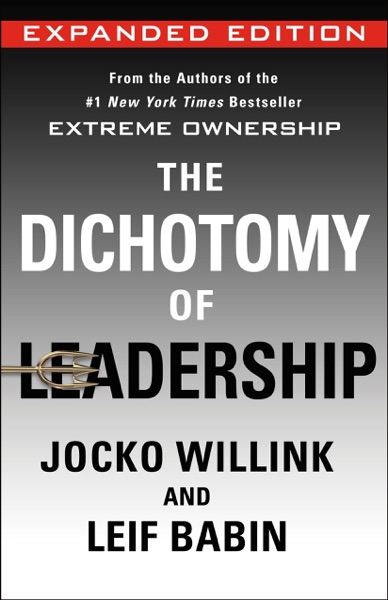
The Dichotomy of Leadership
📖 About the book
The Dichotomy of Leadership by Jocko Willink and Leif Babin, published in 2018, explores the delicate balance required to lead effectively. The authors argue that every leadership trait, when taken to an extreme, becomes a weakness. This book provides a rigorous framework for navigating the Conflicting Forces of management, such as the need to be aggressive but not overbearing, and the need to be disciplined but not rigid, fundamentally changing how leaders view their personal development.
The core methodology identifies Twelve Dichotomies that every leader must master, including 'Leading yet also Following' and 'Humble but Not Passive.' Willink and Babin explain how to find the Strategic Middle Ground where a leader can be most effective. They detail the importance of Decentralized Command and the risks of both micromanagement and total detachment. The framework stresses that leadership is a constant adjustment process, requiring high levels of self-awareness to prevent the organization from drifting into dysfunction due to an unbalanced leadership style.
This is crucial reading for senior executives, startup founders, and anyone leading diverse teams. Readers gain concrete value by learning how to recognize when they have pushed a positive trait too far. Practical applications include utilizing Styles Audits for the executive team and implementing 'Red Team' exercises to challenge strategic assumptions. By mastering the dichotomy of leadership, managers can ensure they remain flexible and balanced, leading their organizations to sustained high-performance through Disciplined Adaptability.
💡 Key takeaways
Achieve Leadership Balance by recognizing that every positive trait has a corresponding 'dichotomy' that must be managed to prevent it from becoming a strategic liability.
Avoid the traps of Micromanagement and Over-Detachment by implementing a 'Decentralized Command' that provides clear intent while allowing for local initiative.
Cultivate Aggressive Humility, maintaining a drive for victory and innovation while remaining open to the ideas and critiques of your team members.
❓ FAQ
Is "The Dichotomy of Leadership" by Jocko Willink free to download?
Yes. BookHubs provides a free preview for "The Dichotomy of Leadership". For the full legal text we link to OpenLibrary (Internet Archive), which is also free to read.
What is "The Dichotomy of Leadership" about?
Free download of Jocko Willink's guide to balance. Learn how to manage the conflicting traits required for high-performance leadership and success.
How long does it take to read "The Dichotomy of Leadership"?
At an average reading pace of ~250 words per minute, "The Dichotomy of Leadership" (320 pages) takes roughly 480 minutes — about 8.0 hours. The 3 key takeaways on this page cover the core ideas in under 5 minutes.
What is the ISBN of "The Dichotomy of Leadership"?
The ISBN of "The Dichotomy of Leadership" by Jocko Willink is 978-1250156945, published by St. Martin's Press.
📚 Related books
All books →
The 21 Irrefutable Laws of Leadership
John Maxwell

Dare to Lead
Brené Brown

How to Win Friends and Influence People
Dale Carnegie

Shoe Dog
Phil Knight

The Laws of Human Nature
Robert Greene

Think Again
Adam Grant