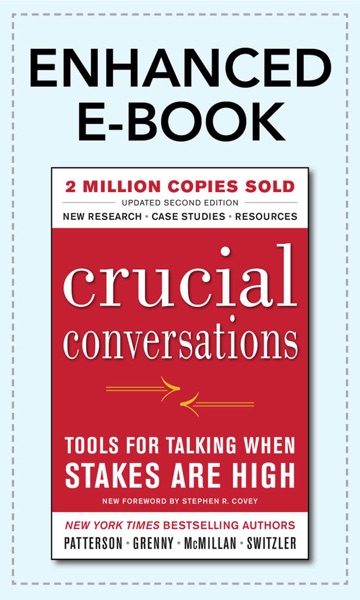
Crucial Conversations
📖 About the book
Crucial Conversations: Tools for Talking When Stakes Are High by Joseph Grenny, Kerry Patterson, and colleagues, is a definitive guide to managing high-stakes interactions. The authors define a 'crucial conversation' as one where stakes are high, opinions vary, and emotions run strong. This book provides a rigorous framework for navigating these moments without falling into the traps of silence (masking, avoiding) or violence (controlling, labeling), ensuring that Strategic Alignment is maintained even under intense pressure.
The core methodology centers on The Pool of Shared Meaning. The authors argue that the more information people can contribute to this pool, the better the final decision will be. They introduce techniques such as Start with Heart (clarifying your own motives) and Make it Safe (detecting when others feel threatened). The framework emphasizes the importance of Mutual Purpose and Mutual Respect as the foundations for healthy dialogue, providing tools to 'contrasting' and 'brainstorming' to find win-win solutions that satisfy all parties.
Essential reading for managers, negotiators, and anyone in a collaborative environment. Readers gain value by learning how to de-escalate tension and turn adversarial encounters into productive problem-solving sessions. Practical applications include utilizing the STATE Path for sharing tough messages and redesigning feedback sessions to favor Psychological Safety. By mastering these tools, leaders can ensure that their most important strategic ideas are discussed openly and executed effectively across the entire organization.
💡 Key takeaways
Utilize the STATE Path (Share your facts, Tell your story, Ask for others' paths, Talk tentatively, Encourage testing) to communicate high-stakes information clearly and persuasively.
Build a Pool of Shared Meaning by encouraging all participants to contribute their perspectives, ensuring that organizational decisions are based on the best collective data.
Identify Safety Outages in real-time by monitoring for signs of silence or verbal aggression, and use 'Contrasting' to clarify your intent and restore professional respect.
❓ FAQ
Is "Crucial Conversations" by Joseph Grenny et al. free to download?
Yes. BookHubs provides a free preview for "Crucial Conversations". For the full legal text we link to OpenLibrary (Internet Archive), which is also free to read.
What is "Crucial Conversations" about?
Free download of Crucial Conversations. Master the skills to step up to high-stakes dialogues when opinions vary and emotions run strong.
How long does it take to read "Crucial Conversations"?
At an average reading pace of ~250 words per minute, "Crucial Conversations" (272 pages) takes roughly 408 minutes — about 6.8 hours. The 3 key takeaways on this page cover the core ideas in under 5 minutes.
What is the ISBN of "Crucial Conversations"?
The ISBN of "Crucial Conversations" by Joseph Grenny et al. is 978-0071771320, published by McGraw-Hill.
📚 Related books
All books →
Atomic Habits
James Clear

Can't Hurt Me
David Goggins

Ego Is the Enemy
Ryan Holiday

Influence
Robert Cialdini

Man's Search for Meaning
Viktor Frankl

Never Split the Difference
Chris Voss