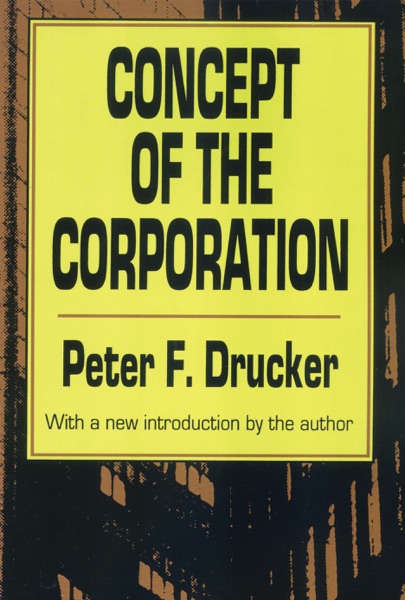
The Concept of the Corporation
📖 About the book
The Concept of the Corporation by Peter Drucker, published in 1946, is a landmark study that essentially founded the field of corporate analysis. After spending two years inside General Motors (GM), then the largest and most successful company in the world, Drucker produced this objective analysis of its internal workings. It was the first book to treat a corporation as a social institution and a political structure rather than just an economic entity, profoundly influencing how we view big business in society.
The book famously details the concept of Federal Decentralization, the system GM used to manage its vast and diverse operations. Drucker shows how this structure provided divisional autonomy while maintaining central control over strategy and capital. He also introduces the idea of the Corporation as a Social System, arguing that a firm's success depends on its ability to provide status and function to its employees. He discusses the importance of the Professional Management Class and the need for large organizations to balance their profit motives with the social needs of a modern industrial community.
This classic is essential for business historians, organizational designers, and corporate executives. Readers gain value by understanding the origins of modern management structures and the social challenges inherent in large-scale organizations. Real-world applications include evaluating the effectiveness of Decentralized Management models and developing corporate social responsibility (CSR) initiatives that align with the firm's core purpose. By studying GM's original success through Drucker's lens, leaders can gain insights into the enduring principles of large-scale organizational design and institutional legitimacy.
💡 Key takeaways
Implement a model of Federal Decentralization to balance the need for divisional agility with the requirement for centralized strategic and financial oversight.
View the Corporation as a Social Institution, recognizing that long-term success requires providing employees with a clear sense of status and function within the system.
Analyze your organization’s internal Management Structure as a political and social entity to identify how power dynamics and culture impact economic performance.
❓ FAQ
Is "The Concept of the Corporation" by Peter Drucker free to download?
Yes. BookHubs provides a free preview for "The Concept of the Corporation". For the full legal text we link to OpenLibrary (Internet Archive), which is also free to read.
What is "The Concept of the Corporation" about?
Download Peter Drucker's landmark study of General Motors for free. Discover the original analysis of corporate structure and decentralization.
How long does it take to read "The Concept of the Corporation"?
At an average reading pace of ~250 words per minute, "The Concept of the Corporation" (330 pages) takes roughly 495 minutes — about 8.3 hours. The 3 key takeaways on this page cover the core ideas in under 5 minutes.
What is the ISBN of "The Concept of the Corporation"?
The ISBN of "The Concept of the Corporation" by Peter Drucker is 978-1560006251, published by John Day Company.
📚 Related books
All books →
7 Habits of Highly Effective People
Stephen Covey

High Output Management
Andrew Grove

The Righteous Mind
Jonathan Haidt

Antifragile
Nassim Taleb

Business Model Generation
Osterwalder, Pigneur

Management
Peter Drucker