Value Proposition Design
📖 About the book
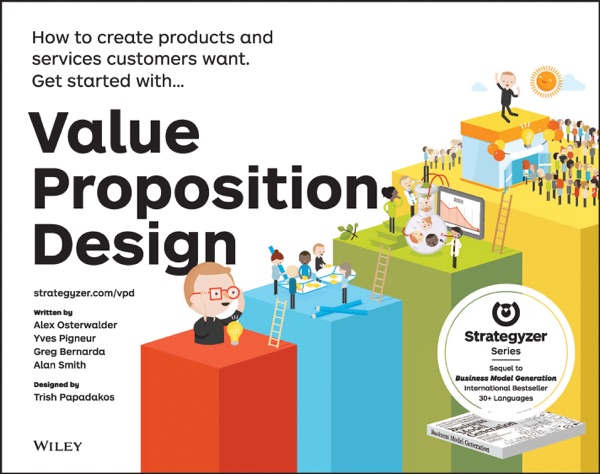
Value Proposition Design by Alexander Osterwalder and his colleagues, published in 2014, is the highly practical follow-up to Business Model Generation. This book zooms in on two specific blocks of the original canvas: Customer Segments and Value Propositions. The authors address the fundamental reason why most products fail: they don't solve a real problem for the customer. This work provides a rigorous process for Customer-Centric Innovation, ensuring that firms build what people will actually pay for.
The book introduces the Value Proposition Canvas (VPC), which consists of the 'Customer Profile' (Jobs, Pains, Gains) and the 'Value Map' (Products & Services, Pain Relievers, Gain Creators). The goal is to achieve Product-Market Fit by aligning the features of the offering with the specific needs and desires of the user. The authors detail a workflow for 'Testing' and 'Evolving' propositions through experiments, emphasizing the importance of Evidence-Based Strategy over guesswork or executive intuition.
This is mandatory reading for product designers, marketers, and entrepreneurs. Readers gain value by learning how to avoid 'inventor's syndrome'—falling in love with a solution before understanding the problem. Practical applications include conducting Customer Interviews to uncover hidden 'jobs to be done' and using the 'Learning Card' to track the results of market experiments. By following this disciplined design process, organizations can drastically reduce the risk of product failure and build a brand that resonates deeply with its target audience.
💡 Key takeaways
Achieve Product-Market Fit by using the Value Proposition Canvas to ensure your offering directly addresses the specific 'Pains' and 'Gains' of your customer segment.
Identify the Jobs to Be Done for your customers, moving beyond surface-level demographics to understand the functional and emotional tasks they are trying to accomplish.
Implement an Experimental Workflow to validate your value proposition with real-world evidence, reducing the risk of investing in products that no one wants to buy.
❓ FAQ
Is "Value Proposition Design" by Osterwalder et al. free to download?
Yes. BookHubs provides a free preview for "Value Proposition Design". For the full legal text we link to OpenLibrary (Internet Archive), which is also free to read.
What is "Value Proposition Design" about?
Download the guide to customer-centric innovation for free. Learn how to create products and services that customers actually want using the VPC.
How long does it take to read "Value Proposition Design"?
At an average reading pace of ~250 words per minute, "Value Proposition Design" (320 pages) takes roughly 480 minutes — about 8.0 hours. The 3 key takeaways on this page cover the core ideas in under 5 minutes.
What is the ISBN of "Value Proposition Design"?
The ISBN of "Value Proposition Design" by Osterwalder et al. is 978-1118968055, published by Wiley.
📚 Related books
All books →
7 Habits of Highly Effective People
Stephen Covey

High Output Management
Andrew Grove

The Righteous Mind
Jonathan Haidt

Antifragile
Nassim Taleb

Business Model Generation
Osterwalder, Pigneur

Management
Peter Drucker