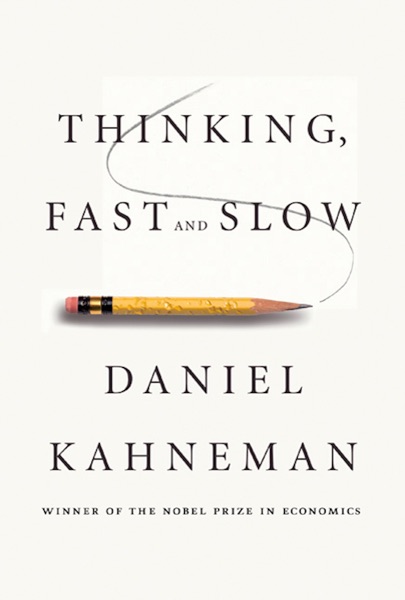
Thinking, Fast and Slow
📖 About the book
Thinking, Fast and Slow by Daniel Kahneman, published in 2011, is a monumental work in the field of Behavioral Economics. Kahneman, a Nobel laureate, explores the two cognitive systems that drive our choices: System 1 (fast, intuitive, emotional) and System 2 (slow, deliberate, logical). This book provides a rigorous framework for understanding why even the most experienced leaders make irrational decisions, fundamentally changing how organizations approach risk management and strategic planning.
The book details dozens of cognitive biases, including Anchoring, Availability Heuristic, and the Loss Aversion principle of Prospect Theory. Kahneman explains how 'System 1' often takes over and creates errors of judgment that 'System 2' fails to correct. He introduces the concept of Noise—unwanted variability in judgments—and provides techniques for 'Adversarial Collaboration' to improve the quality of organizational forecasting. The focus is on moving from 'Intuitive Guesswork' toward Data-Driven Rationality, recognizing that our brains are not naturally designed for statistical thinking.
This is mandatory reading for investors, strategic analysts, and CEOs. Readers gain value by learning how to recognize their own professional blind spots and how to design Decision-Making Architectures that minimize bias. Practical applications include utilizing 'Premortems' to identify project risks and redesigning incentive systems to account for loss aversion. By internalizing Kahneman’s insights, leaders can build more resilient organizations and make higher-quality strategic choices that are grounded in a deep understanding of human psychology.
💡 Key takeaways
Recognize the dominance of System 1 Thinking in your organization's daily operations, intentionally activating System 2 for high-stakes strategic decisions that require rigorous analysis.
Mitigate the impact of Loss Aversion by reframing strategic choices to focus on total expected value rather than the emotional fear of short-term setbacks.
Implement Decision Hygiene protocols to reduce 'Noise' and bias in your firm's evaluations, ensuring that your leadership team's judgments are consistent and data-grounded.
❓ FAQ
Is "Thinking, Fast and Slow" by Daniel Kahneman free to download?
Yes. BookHubs provides a free preview for "Thinking, Fast and Slow". For the full legal text we link to OpenLibrary (Internet Archive), which is also free to read.
What is "Thinking, Fast and Slow" about?
Free download of the Nobel Prize winner's masterpiece. Master the science of decision-making and learn to overcome cognitive biases in leadership.
How long does it take to read "Thinking, Fast and Slow"?
At an average reading pace of ~250 words per minute, "Thinking, Fast and Slow" (499 pages) takes roughly 749 minutes — about 12.5 hours. The 3 key takeaways on this page cover the core ideas in under 5 minutes.
What is the ISBN of "Thinking, Fast and Slow"?
The ISBN of "Thinking, Fast and Slow" by Daniel Kahneman is 978-0374275631, published by Farrar, Straus and Giroux.
📚 Related books
All books →
Atomic Habits
James Clear

Can't Hurt Me
David Goggins

Ego Is the Enemy
Ryan Holiday

Influence
Robert Cialdini

Man's Search for Meaning
Viktor Frankl

Never Split the Difference
Chris Voss