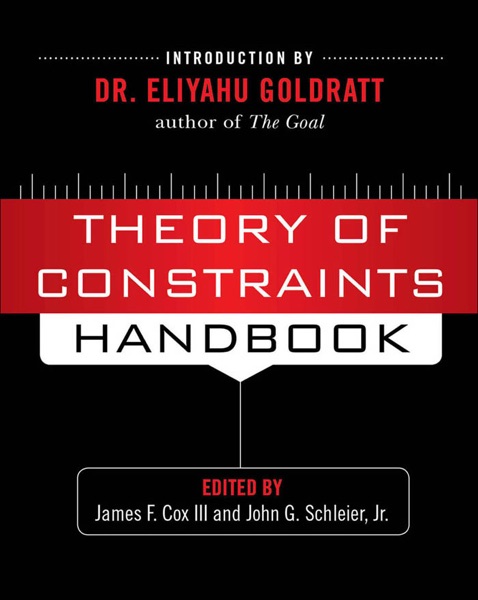
Theory of Constraints
📖 About the book
Theory of Constraints by Eliyahu Goldratt, published in 1990, provides the philosophical and theoretical foundation for the methodologies he popularized in his business novel, The Goal. Goldratt, an Israeli physicist turned management guru, outlines a systemic approach to continuous improvement that challenges traditional cost accounting and local optimization. This book is a deep dive into the logic of systems thinking, demonstrating how focusing on the weakest link in a chain is the only way to significantly improve overall performance.
The core philosophy is the Theory of Constraints (TOC), which posits that every complex system is limited from achieving its goals by at least one constraint (or bottleneck). The book details the Five Focusing Steps: identify the constraint, exploit it, subordinate everything else to it, elevate the constraint, and then repeat the process. Goldratt also introduces the Thinking Processes, a suite of logical tools (like the Evaporating Cloud and Current Reality Tree) designed to help managers answer three critical questions: What to change? What to change to? How to cause the change?
Essential for industrial engineers, supply chain managers, and operations directors, this book offers a paradigm shift in how to measure and manage productivity. Readers gain the ability to stop wasting resources on non-bottleneck improvements that do not impact the bottom line. Real-world applications include identifying hidden policy constraints that slow down production and utilizing the "Drum-Buffer-Rope" scheduling method to optimize workflow. By mastering TOC, organizations can drastically reduce lead times, lower inventory, and increase throughput.
💡 Key takeaways
Apply the Five Focusing Steps to systematically identify and manage the bottlenecks in your operations, ensuring that improvement efforts actually increase total throughput.
Shift away from local optimization (making every department highly efficient) and instead Subordinate all processes to the pace of the system's primary constraint.
Utilize TOC Thinking Processes like the Evaporating Cloud to systematically identify the root causes of systemic conflicts and design breakthrough solutions.
❓ FAQ
Is "Theory of Constraints" by Eliyahu Goldratt free to download?
Yes. BookHubs provides a free preview for "Theory of Constraints". For the full legal text we link to OpenLibrary (Internet Archive), which is also free to read.
What is "Theory of Constraints" about?
Download Theory of Constraints for free. Discover Eliyahu Goldratt's systemic approach to continuous improvement by identifying and managing bottlenecks.
How long does it take to read "Theory of Constraints"?
At an average reading pace of ~250 words per minute, "Theory of Constraints" (175 pages) takes roughly 263 minutes — about 4.4 hours. The 3 key takeaways on this page cover the core ideas in under 5 minutes.
What is the ISBN of "Theory of Constraints"?
The ISBN of "Theory of Constraints" by Eliyahu Goldratt is 978-0884271666, published by North River Press.
📚 Related books
All books →
7 Habits of Highly Effective People
Stephen Covey

High Output Management
Andrew Grove

The Righteous Mind
Jonathan Haidt

Antifragile
Nassim Taleb

Business Model Generation
Osterwalder, Pigneur

Management
Peter Drucker