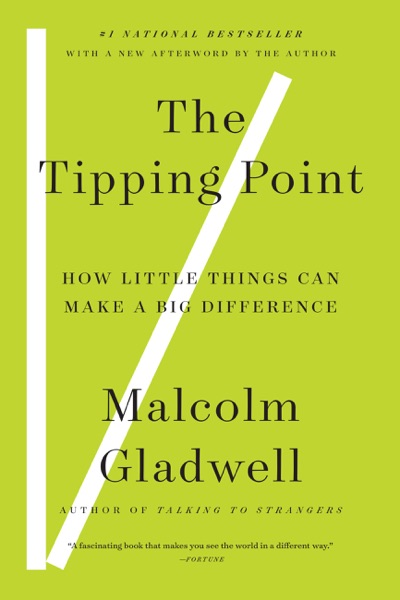
The Tipping Point
📖 About the book
The Tipping Point: How Little Things Can Make a Big Difference by Malcolm Gladwell, published in 2000, explores the moment when a trend, a virus, or a business idea crosses a threshold and spreads like wildfire. Gladwell argues that social change behaves like an epidemic, requiring specific conditions to reach a state of Mass Contagion. This work provides a rigorous framework for leaders to identify the 'leverage points' in their markets and cultures, teaching them how to drive explosive growth through minimal, targeted interventions.
The core methodology centers on the Three Rules of Epidemics: The Law of the Few, The Stickiness Factor, and The Power of Context. Gladwell introduces the three types of social influencers: Connectors (who know everyone), Mavens (information specialists), and Salesmen (persuaders). He explains how small adjustments to a product's presentation can make it 'stick' in the customer's mind and how the 'Environment' determines individual behavior. The focus is on moving from 'Broad-Scale Marketing' toward Viral Strategy based on social dynamics and psychological triggers.
Essential reading for marketing directors, social entrepreneurs, and startup founders. Readers gain concrete value by learning how to spark Word-of-Mouth Epidemics for their ideas. Practical applications include utilizing Influencer Mapping to find Mavens in your industry and redesigning product messages to increase their Stickiness. By mastering Gladwell’s principles, leaders can create 'tipping points' that transform niche products into global phenomena and stagnant corporate cultures into engines of rapid innovation.
💡 Key takeaways
Leverage The Law of the Few by identifying and engaging the Connectors, Mavens, and Salesmen in your market who have the social power to spread your brand's epidemic.
Enhance your Stickiness Factor by making small, high-impact changes to your strategic message, ensuring that it is memorable and compels the audience to take action.
Optimize The Power of Context by recognizing that subtle shifts in the organizational or market environment can determine whether a new initiative succeeds or fails.
❓ FAQ
Is "The Tipping Point" by Malcolm Gladwell free to download?
Yes. BookHubs provides a free preview for "The Tipping Point". For the full legal text we link to OpenLibrary (Internet Archive), which is also free to read.
What is "The Tipping Point" about?
Free download of the classic on social epidemics. Learn how small changes can make a big difference and how to reach the 'tipping point' for your brand.
How long does it take to read "The Tipping Point"?
At an average reading pace of ~250 words per minute, "The Tipping Point" (288 pages) takes roughly 432 minutes — about 7.2 hours. The 3 key takeaways on this page cover the core ideas in under 5 minutes.
What is the ISBN of "The Tipping Point"?
The ISBN of "The Tipping Point" by Malcolm Gladwell is 978-0316346627, published by Little, Brown and Company.
📚 Related books
All books →
Atomic Habits
James Clear

Can't Hurt Me
David Goggins

Ego Is the Enemy
Ryan Holiday

Influence
Robert Cialdini

Man's Search for Meaning
Viktor Frankl

Never Split the Difference
Chris Voss