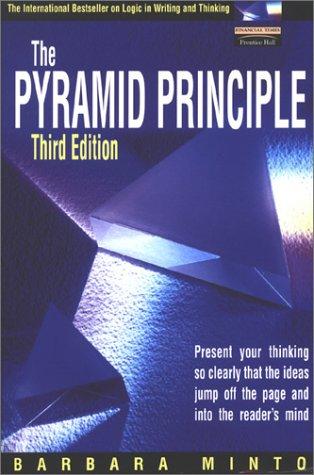
The Pyramid Principle
📖 About the book
The Pyramid Principle by Barbara Minto, first published in 1987, is the definitive guide to structured thinking and communication used by elite management consulting firms like McKinsey & Company. Minto argues that to be persuasive, one must present ideas in the order that best matches how the human brain processes information. This book provides a rigorous, Logic-Based Framework for writing and presenting that has become the gold standard for executive communication and strategic problem-solving worldwide.
The core methodology centers on Top-Down Communication. Minto explains that a professional must state the conclusion first, followed by the supporting arguments grouped into logical categories. She introduces the MECE Principle (Mutually Exclusive, Collectively Exhaustive) to ensure that arguments are comprehensive and free of overlaps. The book details techniques for Vertical and Horizontal Logic, showing how to build a 'pyramid' of ideas where each level summarizes the points below it. The focus is on clarity, brevity, and the use of the 'S-C-Q' (Situation, Complication, Question) narrative to hook the audience.
This is essential reading for analysts, consultants, and senior executives who need to influence high-level decision-makers. Readers gain value by learning how to cut through complexity and present 'airtight' logical cases. Real-world applications include utilizing Storyboarding for executive presentations and restructuring corporate reports to favor Deductive and Inductive Reasoning. By mastering the Minto Pyramid, professionals can significantly increase their personal influence and ensure that their strategic recommendations are understood and acted upon by busy leadership teams.
💡 Key takeaways
Utilize Top-Down Communication by stating your primary recommendation first, followed by supporting logic to match the brain’s natural information-processing patterns.
Apply the MECE Principle (Mutually Exclusive, Collectively Exhaustive) to your problem-solving to ensure that your analysis is comprehensive and logically distinct.
Master the S-C-Q Framework (Situation, Complication, Question) to frame your strategic ideas as a compelling narrative that immediately captures executive attention and focus.
❓ FAQ
Is "The Pyramid Principle" by Barbara Minto free to download?
Yes. BookHubs provides a free preview for "The Pyramid Principle". For the full legal text we link to OpenLibrary (Internet Archive), which is also free to read.
What is "The Pyramid Principle" about?
Free download of the McKinsey classic on structured thinking. Master the Pyramid Principle to communicate complex ideas with absolute clarity and logic.
How long does it take to read "The Pyramid Principle"?
At an average reading pace of ~250 words per minute, "The Pyramid Principle" (178 pages) takes roughly 267 minutes — about 4.5 hours. The 3 key takeaways on this page cover the core ideas in under 5 minutes.
What is the ISBN of "The Pyramid Principle"?
The ISBN of "The Pyramid Principle" by Barbara Minto is 978-0273710516, published by Financial Times/Prentice Hall.
📚 Related books
All books →
The 21 Irrefutable Laws of Leadership
John Maxwell

Dare to Lead
Brené Brown

How to Win Friends and Influence People
Dale Carnegie

Shoe Dog
Phil Knight

The Laws of Human Nature
Robert Greene

Think Again
Adam Grant