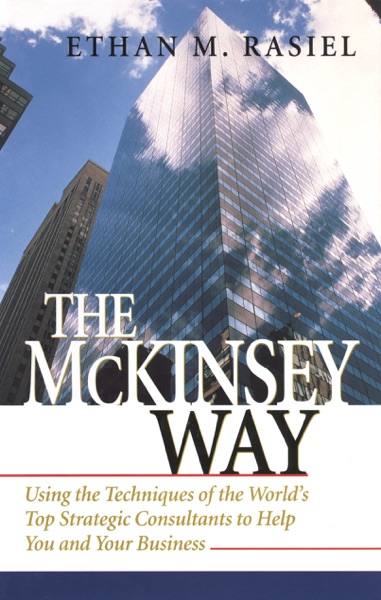
The McKinsey Way
by Ethan Rasiel
📖 About the book
The McKinsey Way by Ethan Rasiel, published in 1999, provides a rare and valuable look into the internal operating procedures of McKinsey & Company, the world's most prestigious management consulting firm. Rasiel, a former McKinsey associate, demystifies the firm’s legendary problem-solving techniques and communication strategies. This book serves as a practical toolkit for any professional looking to apply the same Analytical Rigor and structured thinking to their own business challenges, regardless of their industry or position.
The core of the book is the McKinsey approach to problem-solving, which begins with the MECE (Mutually Exclusive, Collectively Exhaustive) principle. Rasiel explains how to break down complex problems into logical, manageable pieces without overlaps or gaps. He details the use of the 80/20 Rule to prioritize efforts, the "Initial Hypothesis" to guide research, and the importance of fact-based analysis. He also provides insights into McKinsey's unique Communication Style, including the "Elevator Pitch" and the use of structured presentations to win over skeptical clients and senior management.
This is essential reading for aspiring consultants, business analysts, and managers who need to improve their strategic clarity. Readers gain value by learning how to cut through corporate noise and focus on the drivers of value. Real-world applications include using the MECE Framework for organizational design and applying structured communication to influence executive decision-making. By adopting the McKinsey way, professionals can enhance their personal productivity and become more effective at solving the most difficult and high-stakes problems facing their organizations.
💡 Key takeaways
Utilize the MECE Principle (Mutually Exclusive, Collectively Exhaustive) to structure your thinking and ensure that no part of a complex problem is overlooked or repeated.
Apply the 80/20 Rule to your analysis, focusing your time and resources on the 20% of activities that drive 80% of the value and results for your project.
Master Structured Communication by using the 'Initial Hypothesis' and 'Elevator Pitch' techniques to present complex ideas clearly and persuasively to senior leadership.
❓ FAQ
Is "The McKinsey Way" by Ethan Rasiel free to download?
Yes. BookHubs provides a free preview for "The McKinsey Way". For the full legal text we link to OpenLibrary (Internet Archive), which is also free to read.
What is "The McKinsey Way" about?
Download the insider's guide to McKinsey's problem-solving methods for free. Master MECE, the 80/20 rule, and structured communication.
How long does it take to read "The McKinsey Way"?
At an average reading pace of ~250 words per minute, "The McKinsey Way" (187 pages) takes roughly 281 minutes — about 4.7 hours. The 3 key takeaways on this page cover the core ideas in under 5 minutes.
What is the ISBN of "The McKinsey Way"?
The ISBN of "The McKinsey Way" by Ethan Rasiel is 978-0070534483, published by McGraw-Hill.
📚 Related books
All books →
7 Habits of Highly Effective People
Stephen Covey

High Output Management
Andrew Grove

The Righteous Mind
Jonathan Haidt

Antifragile
Nassim Taleb

Business Model Generation
Osterwalder, Pigneur

Management
Peter Drucker