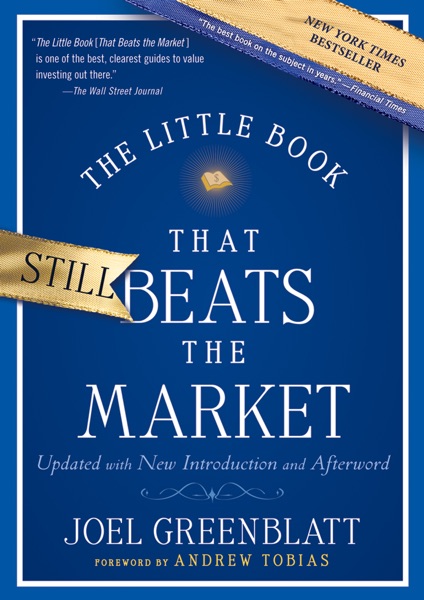
The Little Book That Still Beats the Market
📖 About the book
The Little Book That Still Beats the Market by Joel Greenblatt, published in 2005 (updated in 2010), provides a rigorous, Rule-Based Framework for value investing. Greenblatt, founder of Gotham Capital, argues that anyone can beat the market by applying a simple 'Magic Formula' that focuses on two key variables: Earnings Yield (buying cheap) and Return on Capital (buying good businesses). This work provides a systematic roadmap for building a high-performance portfolio by automating the selection of undervalued, high-quality companies.
The core methodology centers on the Magic Formula Ranking, which identifies the top companies that combine high profitability with low valuation. Greenblatt explains the importance of Emotional Discipline—trusting the system even during periods of short-term underperformance. He introduces the concept of the 'Time Horizon' and provide techniques for 'Portfolio Rebalancing.' The focus is on moving from 'Subjective Guessing' toward Empirical Strategy, where the investor relies on the historical tendency of the market to reward efficient capital use.
Essential reading for retail investors and financial advisors looking for a Systematized Value Strategy. Readers gain concrete value by learning how to calculate 'Return on Invested Capital' (ROIC). Practical applications include utilizing the Formula Screener to find investment ideas and implementing a 'Buy and Hold for One Year' discipline. By mastering Greenblatt’s simple logic, individuals can build a secure financial future and achieve superior returns without the need for complex analysis or professional management fees.
💡 Key takeaways
Implement a Quantitative Selection Process based on Earnings Yield and Return on Capital to ensure your organization is acquiring the most efficient and undervalued strategic assets.
Practice Strategic Patience, recognizing that even the most effective systematic models require multi-year time horizons to outperform the broader market indexes.
Focus on Capital Efficiency (ROIC) as your primary measure of business quality, identifying firms that generate the highest returns on the money they reinvest in their operations.
❓ FAQ
Is "The Little Book That Still Beats the Market" by Joel Greenblatt free to download?
Yes. BookHubs provides a free preview for "The Little Book That Still Beats the Market". For the full legal text we link to OpenLibrary (Internet Archive), which is also free to read.
What is "The Little Book That Still Beats the Market" about?
Free download of the guide to the 'Magic Formula'. Learn Joel Greenblatt's simple strategy to achieve superior stock market returns with low risk.
How long does it take to read "The Little Book That Still Beats the Market"?
At an average reading pace of ~250 words per minute, "The Little Book That Still Beats the Market" (208 pages) takes roughly 312 minutes — about 5.2 hours. The 3 key takeaways on this page cover the core ideas in under 5 minutes.
What is the ISBN of "The Little Book That Still Beats the Market"?
The ISBN of "The Little Book That Still Beats the Market" by Joel Greenblatt is 978-0470624159, published by Wiley.
📚 Related books
All books →
Margin of Safety
Seth Klarman

Misbehaving
Richard H. Thaler

Poor Charlie's Almanack
Charlie Munger

The Big Short
Michael Lewis

The Intelligent Investor
Benjamin Graham

Think and Grow Rich
Napoleon Hill