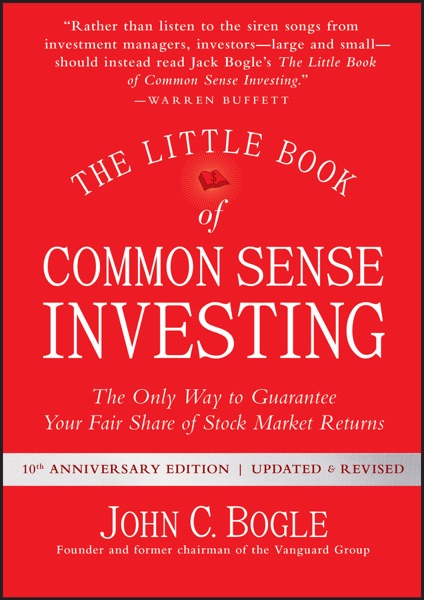
The Little Book of Common Sense Investing
📖 About the book
The Little Book of Common Sense Investing by John C. Bogle, published in 2007, is a concise and powerful manifesto for Index Investing. Bogle, the founder of Vanguard, argues that the financial industry is designed to strip wealth from investors through high fees and complex products. This book provides a rigorous framework for individuals to capture their 'fair share' of market returns by utilizing low-cost index funds, emphasizing that in the world of finance, 'You get what you *don't* pay for.'
The core methodology centers on the Relentless Rules of Humble Arithmetic—the fact that gross returns minus costs equals net return. Bogle explains why Turnover and Taxes are the 'Silent Killers' of wealth and details the role of 'Reversion to the Mean' in mutual fund performance. He introduces the concept of the Traditional Index Fund (TIF) and provides strategies for 'Long-Term Ownership.' The focus is on moving from 'Speculative Trading' toward Investment Stewardship based on the growth of corporate earnings and dividends.
Essential reading for retail investors, HR directors managing 401(k) plans, and fiduciary advisors. Readers gain value by learning how to filter out the 'Noise' of Wall Street. Practical applications include utilizing Low-Expense Ratios as the primary selection criterion for funds and implementing 'Buy and Hold' discipline to minimize transaction costs. By mastering Bogle’s common-sense logic, individuals can build a secure financial future and ensure their capital works for them rather than for the intermediaries of the financial system.
💡 Key takeaways
Prioritize Low-Cost Index Funds as your primary investment vehicle, recognizing that minimizing management fees is the single most effective way to increase your organization's long-term net returns.
Apply the Principle of Reversion to the Mean to avoid chasing 'hot' mutual funds or sectors, focusing instead on broad-based market participation that captures long-term economic growth.
Commit to a Decades-Long Time Horizon, ignoring short-term market volatility and recognizing that the compounding of dividends and earnings is the only true driver of sustainable wealth.
❓ FAQ
Is "The Little Book of Common Sense Investing" by John C. Bogle free to download?
Yes. BookHubs provides a free preview for "The Little Book of Common Sense Investing". For the full legal text we link to OpenLibrary (Internet Archive), which is also free to read.
What is "The Little Book of Common Sense Investing" about?
Free download of John Bogle's guide to index investing. Learn the 'Common Sense' approach to building wealth through low-cost funds and long-term discipline.
How long does it take to read "The Little Book of Common Sense Investing"?
At an average reading pace of ~250 words per minute, "The Little Book of Common Sense Investing" (216 pages) takes roughly 324 minutes — about 5.4 hours. The 3 key takeaways on this page cover the core ideas in under 5 minutes.
What is the ISBN of "The Little Book of Common Sense Investing"?
The ISBN of "The Little Book of Common Sense Investing" by John C. Bogle is 978-1119404507, published by Wiley.
📚 Related books
All books →
Margin of Safety
Seth Klarman

Misbehaving
Richard H. Thaler

Poor Charlie's Almanack
Charlie Munger

The Big Short
Michael Lewis

The Intelligent Investor
Benjamin Graham

Think and Grow Rich
Napoleon Hill