The Innovator's Solution
📖 About the book
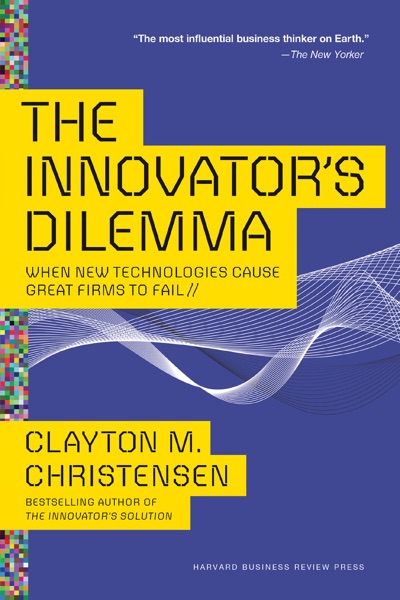
The Innovator's Solution by Clayton Christensen and Michael Raynor is the action-oriented sequel to the landmark The Innovator's Dilemma. Published in 2003, it shifts the focus from diagnosing the problem of disruptive innovation to prescribing actionable strategies for incumbent companies and startups alike. The book provides a practical framework for identifying new growth opportunities and structuring businesses to successfully launch disruptive products, ensuring that companies can become the attackers rather than the victims of market shifts.
A core concept introduced here is the Jobs to Be Done theory. Christensen argues that customers don't simply buy products; they "hire" them to do a specific job. By understanding the underlying job, companies can identify unserved markets and avoid the trap of adding features that customers don't want or need. The authors also distinguish between Low-End Disruption (targeting overserved customers) and New-Market Disruption (targeting non-consumers). They provide guidance on Sustaining vs. Disruptive Growth, detailing how to allocate resources and structure the organization to support fundamentally different types of business models.
This book is essential for product developers, corporate strategists, and venture capitalists. Readers gain concrete value by learning how to systematically predict whether a new idea has disruptive potential before investing heavily. Real-world applications include restructuring product development processes around "jobs" rather than demographics and creating independent business units to foster new disruptive ventures without the crushing expectations of the core business. By mastering these strategies, leaders can build an engine for predictable, sustainable growth.
💡 Key takeaways
Apply the Jobs to Be Done framework to understand the functional and emotional reasons customers purchase products, revealing hidden opportunities for innovation.
Determine whether your new product idea represents a Low-End Disruption or a New-Market Disruption to tailor your marketing and development strategies effectively.
Protect disruptive ventures from internal corporate antibodies by creating autonomous business units that are not forced to meet the margin requirements of the core business.
❓ FAQ
Is "The Innovator's Solution" by Clayton Christensen free to download?
Yes. BookHubs provides a free preview for "The Innovator's Solution". For the full legal text we link to OpenLibrary (Internet Archive), which is also free to read.
What is "The Innovator's Solution" about?
Download The Innovator's Solution for free. Learn how to create sustainable, successful growth and become the disruptor instead of the disrupted.
How long does it take to read "The Innovator's Solution"?
At an average reading pace of ~250 words per minute, "The Innovator's Solution" (304 pages) takes roughly 456 minutes — about 7.6 hours. The 3 key takeaways on this page cover the core ideas in under 5 minutes.
What is the ISBN of "The Innovator's Solution"?
The ISBN of "The Innovator's Solution" by Clayton Christensen is 978-1578518524, published by Harvard Business Review Press.
📚 Related books
All books →
7 Habits of Highly Effective People
Stephen Covey

High Output Management
Andrew Grove

The Righteous Mind
Jonathan Haidt

Antifragile
Nassim Taleb

Business Model Generation
Osterwalder, Pigneur

Management
Peter Drucker