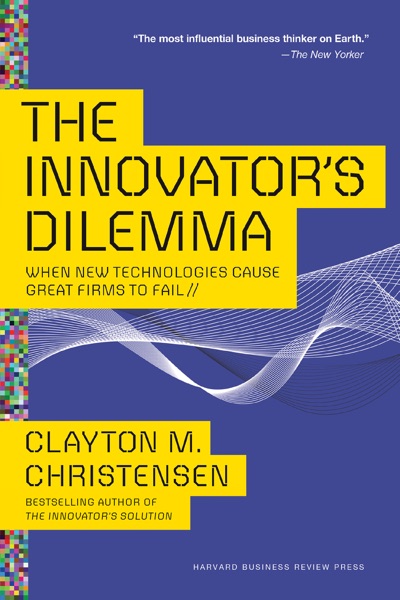
The Innovator's Dilemma
📖 About the book
The Innovator's Dilemma by Clayton Christensen, published in 1997, is a groundbreaking work that changed how the world thinks about innovation. Christensen, a Harvard professor, explains why even the most well-managed companies can fail despite doing everything right—listening to customers and investing in quality. This book introduced the concept of disruption to the mainstream, providing a vital framework for understanding how smaller, nimbler competitors can take down industry giants by targeting overlooked market segments.
The central concept is Disruptive Innovation, which occurs when a smaller company with fewer resources is able to successfully challenge established incumbent businesses. Christensen distinguishes this from Sustaining Innovation, which merely improves existing products for current customers. He argues that incumbents are often held captive by their most profitable customers and high margins, leaving them unable to respond to cheaper, simpler innovations that eventually move upmarket to replace them. He introduces the Value Network framework to explain how different industries incentivize or inhibit specific types of technological change.
This book is mandatory reading for CEOs, product managers, and investors in the tech space. Readers gain concrete value by learning to identify Low-End Disruption and creating autonomous business units to pursue risky, new-market innovations. Real-world applications include analyzing the "Job to be Done" for customers and protecting fledgling projects from the resource-allocation demands of the core business. By mastering Christensen's theories, leaders can anticipate market shifts and disrupt themselves before a competitor does, ensuring long-term survival in an era of rapid technological change.
💡 Key takeaways
Distinguish between Sustaining Innovation and Disruptive Innovation to correctly allocate resources for long-term growth and defense against newcomers.
Identify Low-End Disruptions early by monitoring cheaper, simpler products that target non-consumers or the least profitable segments of your current market.
Establish autonomous business units with their own Value Networks to develop emerging technologies without the interference of the parent company's high-margin requirements.
❓ FAQ
Is "The Innovator's Dilemma" by Clayton Christensen free to download?
Yes. BookHubs provides a free preview for "The Innovator's Dilemma". For the full legal text we link to OpenLibrary (Internet Archive), which is also free to read.
What is "The Innovator's Dilemma" about?
Download The Innovator's Dilemma for free. Learn why great companies fail even when they do everything right and how to manage disruptive innovation.
How long does it take to read "The Innovator's Dilemma"?
At an average reading pace of ~250 words per minute, "The Innovator's Dilemma" (286 pages) takes roughly 429 minutes — about 7.2 hours. The 3 key takeaways on this page cover the core ideas in under 5 minutes.
What is the ISBN of "The Innovator's Dilemma"?
The ISBN of "The Innovator's Dilemma" by Clayton Christensen is 978-0875845852, published by Harvard Business Review Press.
📚 Related books
All books →
7 Habits of Highly Effective People
Stephen Covey

High Output Management
Andrew Grove

The Righteous Mind
Jonathan Haidt

Antifragile
Nassim Taleb

Business Model Generation
Osterwalder, Pigneur

Management
Peter Drucker