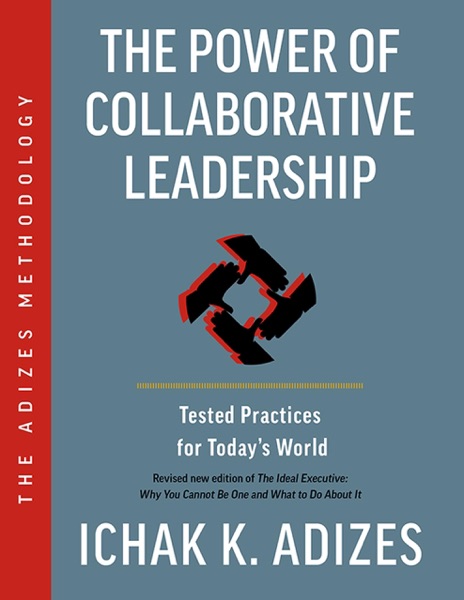
The Ideal Executive
by Ichak Adizes
📖 About the book
The Ideal Executive by Ichak Adizes, published in 2004, provides a profound and liberating truth for leaders: the 'ideal executive' who is perfect at everything does not exist and is, in fact, a myth that causes organizational failure. Adizes, a world-leading expert in organizational health, argues that management is too complex for any one individual. To succeed, an organization needs a Complementary Team of leaders who possess different, often conflicting, strengths and perspectives, working together in an environment of mutual respect.
The core of the book is the PAEI Model, which identifies four essential roles for successful management: Producer (P), Administrator (A), Entrepreneur (E), and Integrator (I). Adizes explains that most leaders are strong in one or two roles but weak in others, leading to specific 'management styles' that can become dysfunctional if not balanced. He emphasizes that the key to Organizational Vitality is not finding a perfect person, but creating a 'collaborative ecosystem' where the P's results are balanced by the A's order, the E's vision, and the I's cohesion.
This is essential reading for CEOs, startup founders, and HR professionals involved in team building. Readers gain value by learning how to diagnose their own leadership style and identify the 'gaps' in their current management team. Real-world applications include redesigning Executive Recruitment to favor complementary skills and utilizing Adizes' techniques to manage the 'constructive conflict' that arises between different PAEI types. By embracing the PAEI framework, leaders can build more balanced, resilient, and effective organizations that outlive any single individual.
💡 Key takeaways
Utilize the PAEI Model (Producer, Administrator, Entrepreneur, Integrator) to identify your own management strengths and the critical gaps in your leadership team.
Stop searching for the 'Perfect Leader' and instead focus on building a Complementary Management Team where different roles balance each other's weaknesses.
Foster a culture of Mutual Trust and Respect to ensure that the natural conflicts between different leadership styles (e.g., Administrator vs. Entrepreneur) remain constructive and strategic.
❓ FAQ
Is "The Ideal Executive" by Ichak Adizes free to download?
Yes. BookHubs provides a free preview for "The Ideal Executive". For the full legal text we link to OpenLibrary (Internet Archive), which is also free to read.
What is "The Ideal Executive" about?
Download Ichak Adizes' management classic for free. Learn why the 'perfect leader' doesn't exist and how to build a complementary management team.
How long does it take to read "The Ideal Executive"?
At an average reading pace of ~250 words per minute, "The Ideal Executive" (256 pages) takes roughly 384 minutes — about 6.4 hours. The 3 key takeaways on this page cover the core ideas in under 5 minutes.
What is the ISBN of "The Ideal Executive"?
The ISBN of "The Ideal Executive" by Ichak Adizes is 978-0937120019, published by Adizes Institute.
📚 Related books
All books →
7 Habits of Highly Effective People
Stephen Covey

High Output Management
Andrew Grove

The Righteous Mind
Jonathan Haidt

Antifragile
Nassim Taleb

Business Model Generation
Osterwalder, Pigneur

Management
Peter Drucker