The Goal
📖 About the book
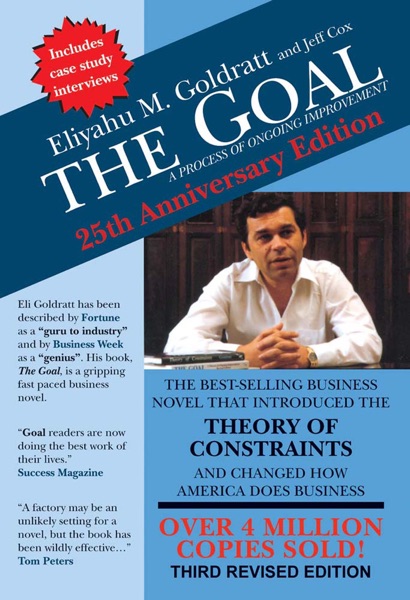
The Goal by Eliyahu Goldratt, first published in 1984, is one of the most influential business books ever written, uniquely presented as a novel. The story follows Alex Rogo, a plant manager who has 90 days to save his failing manufacturing plant from closure. Through the Socratic guidance of his mentor, Jonah, Alex abandons traditional management thinking and discovers the principles of continuous improvement. The book's narrative format makes complex operational theories accessible and immediately applicable to real-world business crises.
The novel introduces the Theory of Constraints (TOC) in a practical setting, fundamentally redefining the ultimate goal of a business: to make money by increasing Throughput while simultaneously decreasing Inventory and Operational Expense. The story vividly illustrates the dangers of local efficiencies (keeping machines busy just to look productive) and introduces the concept of Bottlenecks. Readers learn the "Drum-Buffer-Rope" method for synchronizing production and the realization that a minute lost at a bottleneck is a minute lost for the entire system, whereas a minute saved at a non-bottleneck is a mirage.
This book is mandatory reading for anyone in manufacturing, operations, or project management. Readers gain profound value by learning to identify their organization's true constraints—which are often policies or mental models rather than machines. Practical applications include reorganizing shop-floor schedules to match the capacity of the slowest resource and redefining accounting metrics to reflect actual cash flow rather than paper efficiencies. By internalizing the lessons of The Goal, managers can achieve rapid, dramatic improvements in delivery times and profitability.
💡 Key takeaways
Redefine your operational metrics by focusing exclusively on increasing Throughput while simultaneously driving down Inventory and Operational Expense.
Identify the Bottlenecks in your system and realize that an hour lost at a bottleneck is an hour lost for the entire plant, dictating your true maximum capacity.
Stop optimizing non-bottleneck resources; instead, subordinate all other processes to the pace of the constraint using the Drum-Buffer-Rope scheduling method.
❓ FAQ
Is "The Goal" by Eliyahu Goldratt free to download?
Yes. BookHubs provides a free preview for "The Goal". For the full legal text we link to OpenLibrary (Internet Archive), which is also free to read.
What is "The Goal" about?
Download The Goal by Eliyahu Goldratt for free. Learn the Theory of Constraints through this classic business novel about saving a failing manufacturing plant.
How long does it take to read "The Goal"?
At an average reading pace of ~250 words per minute, "The Goal" (384 pages) takes roughly 576 minutes — about 9.6 hours. The 3 key takeaways on this page cover the core ideas in under 5 minutes.
What is the ISBN of "The Goal"?
The ISBN of "The Goal" by Eliyahu Goldratt is 978-0884271956, published by North River Press.
📚 Related books
All books →
7 Habits of Highly Effective People
Stephen Covey

High Output Management
Andrew Grove

The Righteous Mind
Jonathan Haidt

Antifragile
Nassim Taleb

Business Model Generation
Osterwalder, Pigneur

Management
Peter Drucker