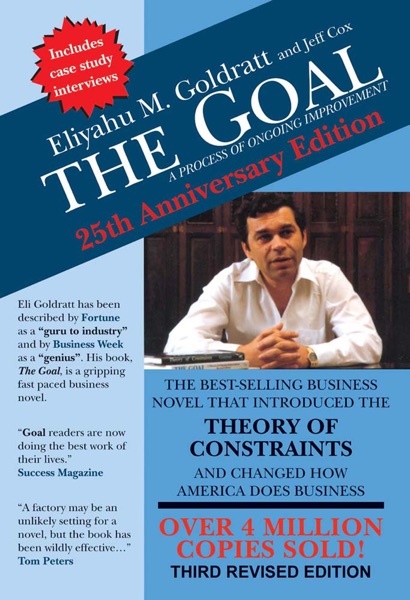
The Goal
📖 About the book
The Goal: A Process of Ongoing Improvement by Eliyahu M. Goldratt, published in 1984, is a business novel that introduced the Theory of Constraints (TOC) to the world. Goldratt argues that every organization has at least one constraint (a bottleneck) that limits its ability to achieve its goal—which is always 'to make money.' This book provides a rigorous framework for Process Optimization, teaching leaders how to manage the system rather than the individual parts.
The core methodology centers on the Five Focusing Steps: Identify the constraint, exploit it, subordinate everything else to it, elevate the constraint, and prevent inertia. Goldratt explains the importance of Throughput, Inventory, and Operating Expense as the primary metrics for success. He introduces the concept of the 'Statistical Fluctuations' and 'Dependent Events,' showing why traditional cost-accounting often leads to poor management decisions. The focus is on moving from 'Local Optimization' toward Global System Efficiency.
Essential reading for COOs, plant managers, and software engineering leads. Readers gain value by learning how to increase Organizational Flow. Practical applications include utilizing 'Drum-Buffer-Rope' for scheduling and implementing Throughput Accounting to guide strategic investments. By internalizing Goldratt’s logic, leaders can build organizations that are structurally faster and more profitable by focusing energy only on the variables that truly limit growth.
💡 Key takeaways
Identify the Organizational Bottleneck (the constraint) that limits your firm's total output, recognizing that an hour lost at the bottleneck is an hour lost for the entire system.
Apply Throughput Accounting by prioritizing initiatives that increase sales (throughput) and decrease inventory, rather than just focusing on incremental cost-cutting.
Avoid Local Optimization of non-constrained resources, as making every department 'busy' often creates excess inventory and reduces total organizational agility.