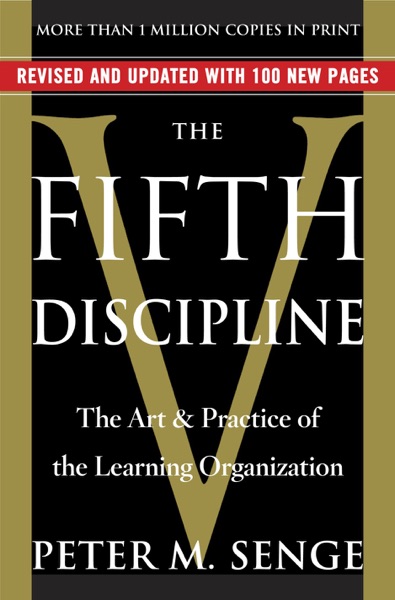
The Fifth Discipline
by Peter Senge
📖 About the book
The Fifth Discipline: The Art & Practice of the Learning Organization by Peter Senge, published in 1990, is a monumental work that redefined the nature of corporate leadership. Senge argues that the only sustainable competitive advantage in a complex world is the ability to learn faster than the competition. This book provides the definitive framework for the Learning Organization, challenging traditional management models that are based on fragmentation and control in favor of a holistic, systems-based approach to institutional growth.
The core framework consists of Five Disciplines: Personal Mastery, Mental Models, Building Shared Vision, Team Learning, and the 'Fifth Discipline'—Systems Thinking. Senge explains how to use Systems Archetypes (like 'Limits to Growth') to diagnose chronic organizational failures and the 'Feedback Loops' that drive complex behavior. He emphasizes the role of the Creative Tension between the current reality and the desired vision. The focus is on moving from 'Local Optimization' toward 'Total Systemic Awareness,' where every employee understands their role in the larger corporate ecosystem.
This book is mandatory reading for CEOs, HR directors, and strategic planners in global enterprises. Readers gain value by learning how to overcome 'learning disabilities' like the 'Illusion of Taking Charge.' Practical applications include conducting Scenario Planning sessions and utilizing 'Dialogue' to surface the collective intelligence of the team. By mastering the five disciplines, leaders can build organizations that are structurally agile, highly innovative, and capable of evolving through any market disruption by tapping into the full potential of their workforce.
💡 Key takeaways
Master Systems Thinking by identifying the underlying interdependencies and feedback loops that determine your organization's long-term performance, rather than fixing surface-level symptoms.
Challenge your organization's Mental Models by encouraging internal debate and reflection, ensuring that outdated assumptions do not sabotage your current strategic goals.
Foster Personal Mastery across your workforce, supporting individual professional growth to build an institutional capability for continuous learning and rapid competitive adaptation.
❓ FAQ
Is "The Fifth Discipline" by Peter Senge free to download?
Yes. BookHubs provides a free preview for "The Fifth Discipline". For the full legal text we link to OpenLibrary (Internet Archive), which is also free to read.
What is "The Fifth Discipline" about?
Free download of Peter Senge's masterpiece for free. Learn the five disciplines of the Learning Organization and master the art of systems thinking.
How long does it take to read "The Fifth Discipline"?
At an average reading pace of ~250 words per minute, "The Fifth Discipline" (424 pages) takes roughly 636 minutes — about 10.6 hours. The 3 key takeaways on this page cover the core ideas in under 5 minutes.
What is the ISBN of "The Fifth Discipline"?
The ISBN of "The Fifth Discipline" by Peter Senge is 978-0385260954, published by Currency.
📚 Related books
All books →
The 21 Irrefutable Laws of Leadership
John Maxwell

Dare to Lead
Brené Brown

How to Win Friends and Influence People
Dale Carnegie

Shoe Dog
Phil Knight

The Laws of Human Nature
Robert Greene

Think Again
Adam Grant