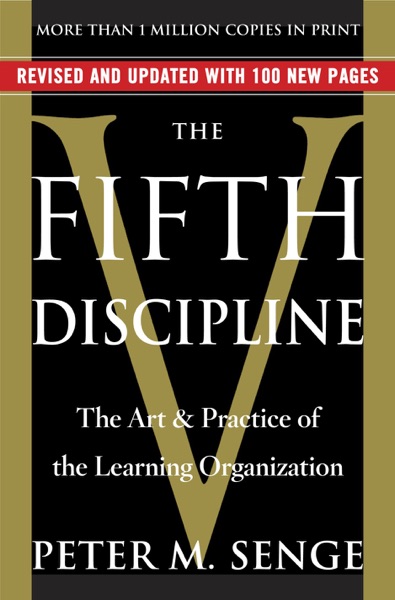
The Fifth Discipline
by Peter Senge
📖 About the book
The Fifth Discipline: The Art & Practice of The Learning Organization by Peter Senge, published in 1990, is a foundational text on Systems Thinking in business. Senge argues that the only sustainable competitive advantage is an organization’s ability to learn faster than its rivals. This book provides a rigorous framework for building Learning Organizations, teaching leaders how to identify the 'Invisible Structures' that cause systemic failure and how to foster collective intelligence through five core disciplines.
The methodology identifies the Five Disciplines: Systems Thinking (the fifth), Personal Mastery, Mental Models, Building Shared Vision, and Team Learning. Senge explains the concept of Archetypes of Failure (like 'Fixes that Backfire' or 'Tragedy of the Commons') and details why Linear Problem-Solving often makes situations worse. He introduces the importance of Creative Tension and provides strategies for 'Dialogue vs. Discussion.' The focus is on moving from 'Adaptive Learning' toward Generative Learning.
Essential reading for CEOs, change management consultants, and project leads. Readers gain concrete value by learning how to use Causal Loop Diagrams. Practical applications include utilizing 'Double-Loop Learning' for post-mortems and implementing Systems-Aware Goal Setting. By mastering Senge’s logic, leaders can build organizations that are structurally more intelligent and less susceptible to the recurring strategic 'dead-ends' of modern management.
💡 Key takeaways
Prioritize Systems Thinking as your primary diagnostic tool, recognizing that market and organizational behaviors are driven by interconnected loops rather than isolated linear causes.
Foster Personal Mastery and Mental Model Awareness within your team, ensuring that every employee understands how their internal assumptions shape the firm's strategic reality.
Leverage Creative Tension between your organization's current reality and its shared vision, utilizing this energy to drive continuous innovation rather than settle for 'good enough' performance.