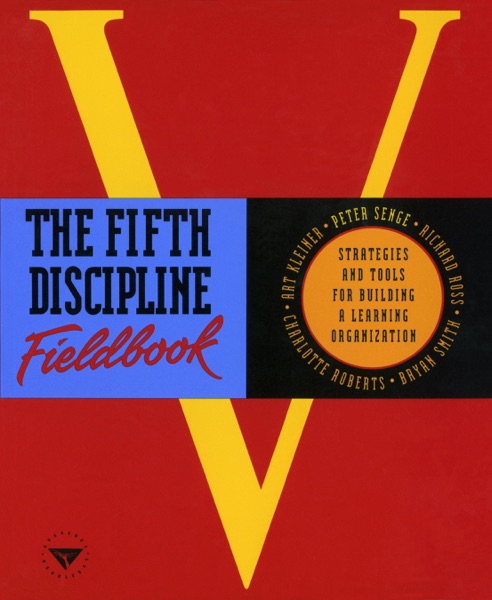
The Fifth Discipline Fieldbook
by Senge et al.
📖 About the book
The Fifth Discipline Fieldbook by Peter Senge and his colleagues is the highly practical companion to the management classic The Fifth Discipline. Published in 1994, it was created in response to thousands of requests for 'how-to' guidance on building a learning organization. This work is a massive toolbox filled with exercises, cases, and techniques designed to help teams and individuals implement the five disciplines of organizational learning in the messy reality of the daily workplace.
The fieldbook provides actionable strategies for the five disciplines: Systems Thinking, Personal Mastery, Mental Models, Shared Vision, and Team Learning. Senge introduces 'The Ladder of Inference' and 'The Left-Hand Column' as tools for exposing the hidden assumptions that lead to conflict. The book details how to use Systems Archetypes to diagnose persistent organizational problems and provides frameworks for Generative Conversation. The focus is on moving from theory to practice, emphasizing that learning is a collective activity that requires both individual courage and institutional support.
Essential for HR directors, team leads, and internal change agents. Readers gain concrete value by learning how to transform their teams into high-performing units capable of self-correction. Practical applications include conducting Scenario Planning workshops and implementing 'Learning Historian' projects to capture institutional knowledge. By utilizing these tools, organizations can overcome 'learning disabilities' and build a culture of continuous innovation that is far more resilient than traditional, command-and-control hierarchies.
💡 Key takeaways
Utilize The Ladder of Inference to help your team identify and challenge the hidden biases and assumptions that frequently lead to faulty strategic decisions.
Apply Systems Archetypes (such as 'Shifting the Burden') to diagnose the underlying causes of recurring organizational problems and design sustainable, long-term solutions.
Foster Team Learning by practicing 'Dialogue'—a specific form of conversation designed to surface the collective intelligence of the group rather than just winning an argument.
❓ FAQ
Is "The Fifth Discipline Fieldbook" by Senge et al. free to download?
Yes. BookHubs provides a free preview for "The Fifth Discipline Fieldbook". For the full legal text we link to OpenLibrary (Internet Archive), which is also free to read.
What is "The Fifth Discipline Fieldbook" about?
Download the practical guide to learning organizations for free. Learn tools and exercises to implement systems thinking and team learning.
How long does it take to read "The Fifth Discipline Fieldbook"?
At an average reading pace of ~250 words per minute, "The Fifth Discipline Fieldbook" (592 pages) takes roughly 888 minutes — about 14.8 hours. The 3 key takeaways on this page cover the core ideas in under 5 minutes.
What is the ISBN of "The Fifth Discipline Fieldbook"?
The ISBN of "The Fifth Discipline Fieldbook" by Senge et al. is 978-0385472562, published by Currency.
📚 Related books
All books →
7 Habits of Highly Effective People
Stephen Covey

High Output Management
Andrew Grove

The Righteous Mind
Jonathan Haidt

Antifragile
Nassim Taleb

Business Model Generation
Osterwalder, Pigneur

Management
Peter Drucker