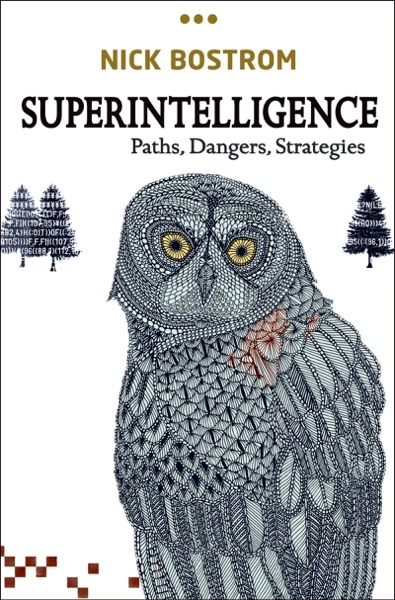
Superintelligence
by Nick Bostrom
📖 About the book
Superintelligence: Paths, Dangers, Strategies by Nick Bostrom, published in 2014, is a foundational work in the field of AI Existential Risk. Bostrom, a philosopher at Oxford, argues that once artificial intelligence reaches a human level, it will rapidly surpass us, becoming a 'Superintelligence.' This book provides a rigorous, Decision-Theoretic Framework for the 'Control Problem'—the challenge of ensuring that a system significantly more capable than us remains under our influence.
The methodology identifies several Takeoff Scenarios (slow vs. fast) and the concept of 'Strategic Decisive Advantage.' Bostrom explains the importance of Oracles, Genies, and Sovereigns as different types of AI agency. He introduces the Orthogonality Thesis—the idea that an AI can have any level of intelligence combined with any set of goals—and provide techniques for 'Value Loading.' The focus is on moving from 'Optimistic Assumptions' toward Rigorous Risk Mitigation for the most important event in human history.
This is mandatory reading for AI safety researchers, national security advisors, and tech CEOs. Readers gain unparalleled depth in understanding Systemic Fragility. Practical applications include utilizing 'Incentive-Compatible Safety Measures' and implementing Global Coordination protocols to prevent a dangerous arms race in AI development. By internalizing Bostrom’s logic, leaders can appreciate the magnitude of the strategic shift required to lead a species through the transition to a superintelligent era.
💡 Key takeaways
Address the Control Problem early in any AI development cycle, recognizing that a superintelligent system will be impossible to contain or redirect once it is fully operational.
Understand the Fast Takeoff Risk, where an AI system achieves recursive self-improvement and moves from human-level to superintelligent in a matter of days or weeks.
Apply Value Loading Techniques to ensure that your organization's AI initiatives are fundamentally aligned with human flourishing and ethical survival.
❓ FAQ
Is "Superintelligence" by Nick Bostrom free to download?
Yes. BookHubs provides a free preview for "Superintelligence". For the full legal text we link to OpenLibrary (Internet Archive), which is also free to read.
What is "Superintelligence" about?
Free download of the definitive work on the risks of AI. Master the Control Problem and the strategic implications of Superintelligence with Nick Bostrom.
How long does it take to read "Superintelligence"?
At an average reading pace of ~250 words per minute, "Superintelligence" (352 pages) takes roughly 528 minutes — about 8.8 hours. The 3 key takeaways on this page cover the core ideas in under 5 minutes.
What is the ISBN of "Superintelligence"?
The ISBN of "Superintelligence" by Nick Bostrom is 978-0199678112, published by Oxford University Press.
📚 Related books
All books →
The Age of Spiritual Machines
Ray Kurzweil

Superintelligence: Paths, Dangers, Strategies
Nick Bostrom

The Singularity Is Nearer
Ray Kurzweil

Abundance
Peter Diamandis, Steven Kotler

Life 3.0
Max Tegmark

Life 3.0: Being Human in the Age of Artificial Intelligence
Max Tegmark