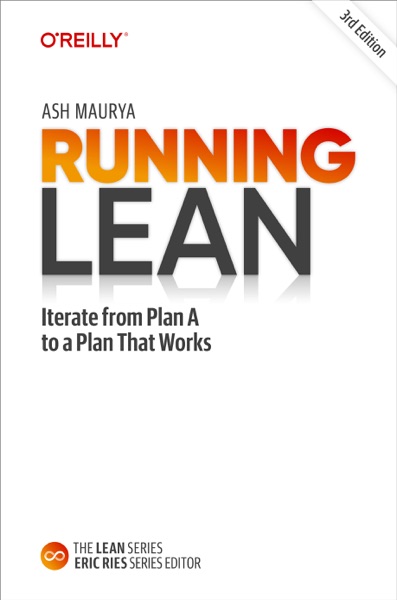
Running Lean
by Ash Maurya
📖 About the book
Running Lean: Iterate from Plan A to a Plan That Works by Ash Maurya, published in 2012, is a highly tactical application of Lean Startup and Customer Development principles. Maurya argues that while many founders understand the theory of agility, they struggle with Execution. This book provides a rigorous, step-by-step framework for entrepreneurs to systematically de-risk their business models and find a repeatable path to Product-Market Fit in an increasingly crowded global market.
The core methodology centers on the Lean Canvas—a one-page adaptation of the Business Model Canvas designed specifically for startups. Maurya explains how to prioritize 'Risk' and details the three stages of a startup: Problem-Solution Fit, Product-Market Fit, and Scale. He introduces the Problem Interview and 'Solution Interview' techniques and provide strategies for 'Learning in Loops.' The focus is on moving from 'Internal Guessing' toward Customer-Driven Validation of every part of the business model.
Essential reading for early-stage founders and product leads. Readers gain value by learning how to use the Unique Value Proposition (UVP) to differentiate their offering. Practical applications include utilizing the '10-Slide Deck' for investors and implementing Kanban-Based Experimentation to track learning progress. By mastering Maurya’s running lean system, leaders can build organizations that are more resilient to failure and more efficient at identifying the high-growth opportunities that competitors miss.
💡 Key takeaways
Utilize the Lean Canvas to visualize and continuously iterate on your organization's business model, ensuring that all nine critical strategic elements are grounded in market evidence.
Conduct rigorous Problem Interviews before writing a single line of code, ensuring that you are solving a 'must-have' problem for a specific and reachable target audience.
Focus your organization's effort on the One Metric That Matters (OMTM) for your current stage of growth, preventing the distraction of vanity metrics and misaligned priorities.
❓ FAQ
Is "Running Lean" by Ash Maurya free to download?
Yes. BookHubs provides a free preview for "Running Lean". For the full legal text we link to OpenLibrary (Internet Archive), which is also free to read.
What is "Running Lean" about?
Free download of the guide to iterative product development. Master the Lean Canvas and the process of achieving Product-Market Fit with Ash Maurya.
How long does it take to read "Running Lean"?
At an average reading pace of ~250 words per minute, "Running Lean" (240 pages) takes roughly 360 minutes — about 6.0 hours. The 3 key takeaways on this page cover the core ideas in under 5 minutes.
What is the ISBN of "Running Lean"?
The ISBN of "Running Lean" by Ash Maurya is 978-1449305178, published by O'Reilly Media.
📚 Related books
All books →
The Hard Thing About Hard Things
Ben Horowitz

The Mom Test
Rob Fitzpatrick

Inspired
Marty Cagan

The Everything Store
Brad Stone

The Lean Startup
Eric Ries

The Snowball
Alice Schroeder