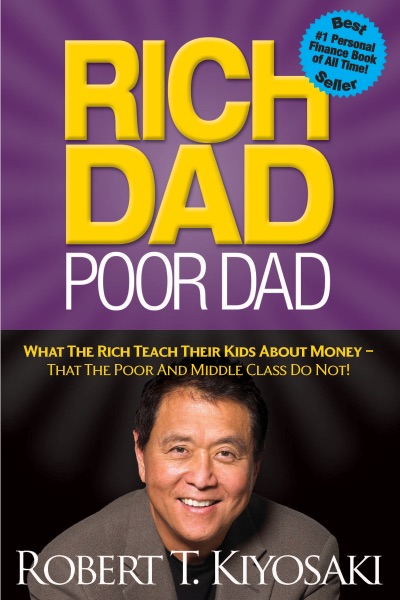
Rich Dad Poor Dad
📖 About the book
Rich Dad Poor Dad by Robert Kiyosaki, published in 1997, is a foundational work that redefined Financial Literacy for a global audience. Kiyosaki argues that traditional education prepares people to be 'good employees' rather than 'wealth creators.' This book provides a rigorous framework for individuals to shift their mindset from working for money to having Money Work for Them, emphasizing that the key to wealth is not high income, but the acquisition of cash-flowing assets.
The core methodology centers on the distinction between Assets and Liabilities. Kiyosaki explains that an asset is something that puts money in your pocket (like rental property or stocks), while a liability is something that takes money out (like a car or a primary residence). He introduces the Cashflow Quadrant and details the importance of 'Financial Intelligence'—the ability to read financial statements and understand tax laws. The focus is on moving from the 'Rat Race' of earned income toward Passive Income Streams and business ownership.
Essential for entrepreneurs, young professionals, and parents. Readers gain concrete value by learning how to identify 'Fake Assets' and how to build a Wealth Engine. Practical applications include utilizing 'Entity Structuring' for tax protection and implementing Strategic Debt to acquire income-producing properties. By internalizing Kiyosaki’s mindset, individuals can break free from dependency on a single paycheck and build a more autonomous and secure professional life based on financial independence and strategic investing.
💡 Key takeaways
Master the Definition of an Asset, focusing your organizational and personal resources on acquiring things that generate ongoing cash flow rather than those that incur ongoing expenses.
Develop Financial Intelligence as a core leadership skill, ensuring you understand the mechanics of taxes, accounting, and legal structures to protect your organization's wealth.
Focus on building Multiple Streams of Passive Income, recognizing that strategic independence is achieved when your asset income exceeds your organizational or personal operating costs.
❓ FAQ
Is "Rich Dad Poor Dad" by Robert Kiyosaki free to download?
Yes. BookHubs provides a free preview for "Rich Dad Poor Dad". For the full legal text we link to OpenLibrary (Internet Archive), which is also free to read.
What is "Rich Dad Poor Dad" about?
Free download of the #1 personal finance book. Learn the difference between assets and liabilities and how to escape the 'Rat Race' with Robert Kiyosaki.
How long does it take to read "Rich Dad Poor Dad"?
At an average reading pace of ~250 words per minute, "Rich Dad Poor Dad" (336 pages) takes roughly 504 minutes — about 8.4 hours. The 3 key takeaways on this page cover the core ideas in under 5 minutes.
What is the ISBN of "Rich Dad Poor Dad"?
The ISBN of "Rich Dad Poor Dad" by Robert Kiyosaki is 978-1612680194, published by Plata Publishing.
📚 Related books
All books →
Margin of Safety
Seth Klarman

Misbehaving
Richard H. Thaler

Poor Charlie's Almanack
Charlie Munger

The Big Short
Michael Lewis

The Intelligent Investor
Benjamin Graham

Think and Grow Rich
Napoleon Hill