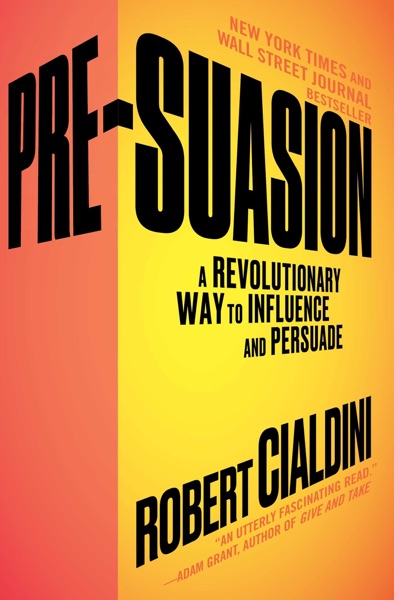
Pre-Suasion
📖 About the book
Pre-Suasion: A Revolutionary Way to Influence and Persuade by Robert Cialdini, published in 2016, explores the Science of Timing in influence. Cialdini argues that the most effective persuaders don't just change what people think, but change what they are paying attention to in the moment before a request is made. This book provides a rigorous framework for Channeling Attention, teaching leaders how to create 'Privileged Moments' of receptivity to ensure their strategic message lands with maximum impact.
The methodology identifies concepts like Anchoring, Priming, and The Unity Principle. Cialdini explains how 'Environmental Cues' (like background music or imagery) can irrationally bias decisions and details the importance of The First 15 Seconds. He introduces the concept of the Focusing Illusion—the idea that whatever we are attending to seems more important than it actually is—and provides strategies for 'Strategic Opening.' The focus is on moving from 'Messaging' toward Architectural Influence.
Essential reading for marketing directors, negotiators, and politicians. Readers gain concrete value by learning how to set the Psychological Stage for a deal. Practical applications include utilizing 'Priming Questions' in sales and implementing Atmospheric Branding for physical and digital offices. By internalizing Cialdini’s logic, leaders can significantly increase their conversion rates by mastering the 'When' and 'Where' of persuasion, not just the 'What.'
💡 Key takeaways
Utilize Strategic Priming to direct your audience's attention toward specific concepts (like quality or safety) before you deliver your core organizational proposal.
Recognize the Power of the 'Privileged Moment', understanding that a person's receptivity to an idea is determined by what they were thinking about immediately prior to its introduction.
Apply the Unity Principle by emphasizing shared identity and 'We-ness', which creates a deep-seated biological receptivity to influence within high-stakes networks.