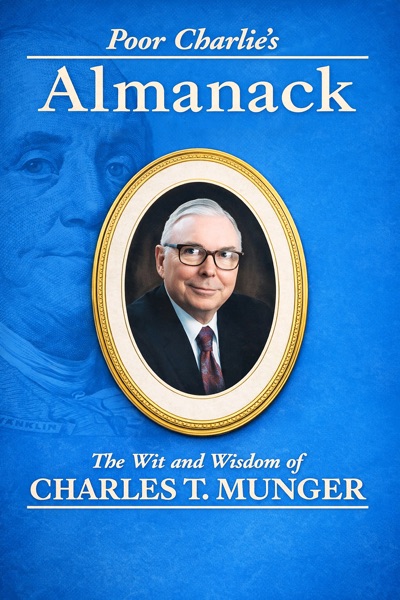
Poor Charlie's Almanack
📖 About the book
Poor Charlie's Almanack: The Wit and Wisdom of Charles T. Munger is an exhaustive collection of speeches and lectures by the Vice Chairman of Berkshire Hathaway. Munger argues that to be a successful investor and leader, one must move beyond specialized knowledge and develop a Lattice of Mental Models from multiple disciplines. This book provides a rigorous framework for Multidisciplinary Thinking, emphasizing that wisdom is the result of synthesizing big ideas from physics, biology, psychology, and economics.
The core methodology centers on the Psychology of Human Misjudgment—identifying the 25 cognitive biases that lead to irrational behavior. Munger explains the importance of Checklist-Based Decision Making and the 'Inversion' technique (approaching problems backward by defining what to avoid). He introduces the concept of the Lollapalooza Effect, where multiple biases act together to produce extreme results. The focus is on building 'Worldly Wisdom' to identify 'Moats'—the sustainable competitive advantages that protect high-quality businesses from competition.
Essential reading for serious investors, business strategists, and analysts. Readers gain value by learning how to avoid the 'Man with a Hammer' syndrome—treating every problem as if it fits their narrow expertise. Practical applications include utilizing Interdisciplinary Audits for investment opportunities and implementing 'Circle of Competence' boundaries to reduce strategic risk. By internalizing Munger’s logic, leaders can develop a more sophisticated and objective worldview, ensuring they make high-quality choices in an increasingly complex and interconnected world.
💡 Key takeaways
Develop a Lattice of Mental Models by internalizing the big ideas from diverse fields, providing you with a more accurate and comprehensive framework for strategic analysis.
Practice Inversion when solving organizational problems, focusing on identifying and eliminating the factors that lead to failure to clarify the path to success.
Master the Psychology of Human Misjudgment to recognize when your own biases—or those of the market—are distorting your perception of strategic value and risk.
❓ FAQ
Is "Poor Charlie's Almanack" by Charlie Munger free to download?
Yes. BookHubs provides a free preview for "Poor Charlie's Almanack". For the full legal text we link to OpenLibrary (Internet Archive), which is also free to read.
What is "Poor Charlie's Almanack" about?
Free download of the wisdom of Charlie Munger. Master the Lattice of Mental Models and the psychology of human misjudgment in investing and life.
How long does it take to read "Poor Charlie's Almanack"?
At an average reading pace of ~250 words per minute, "Poor Charlie's Almanack" (512 pages) takes roughly 768 minutes — about 12.8 hours. The 3 key takeaways on this page cover the core ideas in under 5 minutes.
What is the ISBN of "Poor Charlie's Almanack"?
The ISBN of "Poor Charlie's Almanack" by Charlie Munger is 978-1578645015, published by PCA Publication.
📚 Related books
All books →
Margin of Safety
Seth Klarman

Misbehaving
Richard H. Thaler

The Big Short
Michael Lewis

The Intelligent Investor
Benjamin Graham

Think and Grow Rich
Napoleon Hill

The Wealth of Nations
Adam Smith