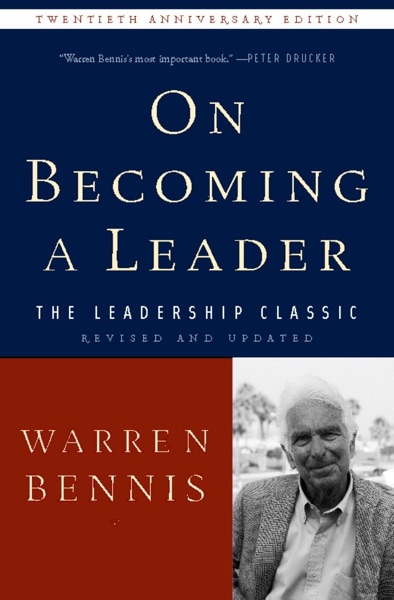
On Becoming a Leader
📖 About the book
On Becoming a Leader by Warren Bennis, published in 1989, is widely considered the most important leadership book of its generation. Bennis, often called the 'father of leadership studies,' argues that leadership is not a set of genetics but a process of self-invention. This book provides a deeply humanistic and philosophical roadmap for individuals to become the 'authors' of their own lives, emphasizing that to lead others, one must first master the Process of Self-Discovery and find a unique voice in a world of conformists.
The core methodology revolves around the transition from 'Manager' to 'Leader.' Bennis identifies the four essential ingredients of leadership: Guiding Vision, Passion, Integrity, and Curiosity. He explains that leaders are defined by their 'crucibles'—the difficult life experiences that force them to grow. He details the importance of Continuous Learning and warns against the 'traps of the institution' that stifle individuality. The focus is on moving beyond technical competence toward the 'maturity of the soul,' where leadership becomes an expression of one's deepest character and purpose.
Essential reading for aspiring executives, educators, and anyone in a transitional phase of life. Readers gain value by learning how to distinguish between their 'Primary' and 'Secondary' selves and how to lead with Authenticity. Practical applications include utilizing Reflection Journals and seeking out mentors who challenge your worldview. By internalizing Bennis’s insights, leaders can build organizations that are more innovative and human, attracting followers who are inspired by a clear sense of character and shared strategic vision.
💡 Key takeaways
Embrace the Self-Invention Process, recognizing that leadership is a skill developed through deep self-awareness and the courage to follow your unique professional calling.
Master the Four Leadership Ingredients—Guiding Vision, Passion, Integrity, and Curiosity—to build a character foundation that inspires trust and followership.
Utilize your Crucible Experiences—your most difficult life challenges—as a source of leadership strength, using them to clarify your core purpose and strategic mission.
❓ FAQ
Is "On Becoming a Leader" by Warren Bennis free to download?
Yes. BookHubs provides a free preview for "On Becoming a Leader". For the full legal text we link to OpenLibrary (Internet Archive), which is also free to read.
What is "On Becoming a Leader" about?
Free download of the leadership classic for free. Learn why 'leaders are made, not born' and how to find your unique voice and mission in life.
How long does it take to read "On Becoming a Leader"?
At an average reading pace of ~250 words per minute, "On Becoming a Leader" (256 pages) takes roughly 384 minutes — about 6.4 hours. The 3 key takeaways on this page cover the core ideas in under 5 minutes.
What is the ISBN of "On Becoming a Leader"?
The ISBN of "On Becoming a Leader" by Warren Bennis is 978-0465014088, published by Basic Books.
📚 Related books
All books →
The 21 Irrefutable Laws of Leadership
John Maxwell

Dare to Lead
Brené Brown

How to Win Friends and Influence People
Dale Carnegie

Shoe Dog
Phil Knight

The Laws of Human Nature
Robert Greene

Think Again
Adam Grant