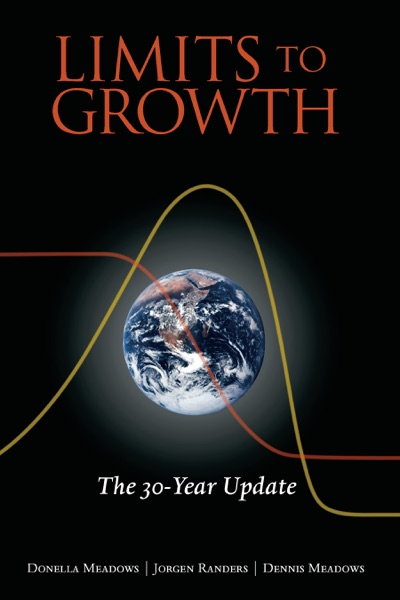
The Limits to Growth
📖 About the book
The Limits to Growth (1972) by Donella Meadows, Dennis Meadows, and others, is the result of the first major Computer Simulation of the World System. The authors argue that on a finite planet, exponential growth in population and industrial output will eventually lead to Systemic Overshoot and subsequent collapse. This work provides a rigorous framework for Dynamic Modeling, teaching leaders how to analyze the five variables—population, food production, industrialization, pollution, and resource depletion—that determine the future of global civilization.
The methodology identifies concepts like Delays in Feedback and the 'carrying capacity' of the environment. The authors explain why 'Technological Fixes' alone cannot prevent collapse without changes in social and economic goals. He introduces the concept of the Steady-State Economy and provides strategies for 'Equilibrium.' The focus is on moving from 'Infinite Growth Assumptions' toward Resilient Stewardship of resources.
Essential reading for long-range strategic planners, ESG directors, and economists. Readers gain concrete value by learning the Mechanics of Global Constraints. Practical applications include utilizing 'Scenario Modeling' for resource security and implementing Circular Value Chains. By internalizing the logic of the Club of Rome report, leaders can build organizations that are better prepared for the inevitable 'Peak' of traditional industrial expansion and positioned for the transition to a sustainable economy.
💡 Key takeaways
Understand the Dynamics of Exponential Growth, recognizing that physical expansion within a finite market system will inevitably hit a ceiling of resource or environmental constraints.
Identify Feedback Delays in your organization's risk management, ensuring you act on environmental and social threats long before the 'Overshoot' becomes visible in financial metrics.
Prioritize Strategic Resilience over Maximum Growth, recognizing that the most sustainable firms are those that can maintain a high-quality 'Steady State' even during periods of market contraction.
❓ FAQ
Is "The Limits to Growth" by Donella Meadows et al. free to download?
Yes. BookHubs provides a free preview for "The Limits to Growth". For the full legal text we link to OpenLibrary (Internet Archive), which is also free to read.
What is "The Limits to Growth" about?
Free download of the seminal report on global resource modeling. Learn about 'Overshoot and Collapse' and the future of industrial growth.
How long does it take to read "The Limits to Growth"?
At an average reading pace of ~250 words per minute, "The Limits to Growth" (205 pages) takes roughly 308 minutes — about 5.1 hours. The 3 key takeaways on this page cover the core ideas in under 5 minutes.
What is the ISBN of "The Limits to Growth"?
The ISBN of "The Limits to Growth" by Donella Meadows et al. is 978-1931498586, published by Chelsea Green Publishing.
📚 Related books
All books →
7 Habits of Highly Effective People
Stephen Covey

High Output Management
Andrew Grove

The Righteous Mind
Jonathan Haidt

Antifragile
Nassim Taleb

Business Model Generation
Osterwalder, Pigneur

Management
Peter Drucker