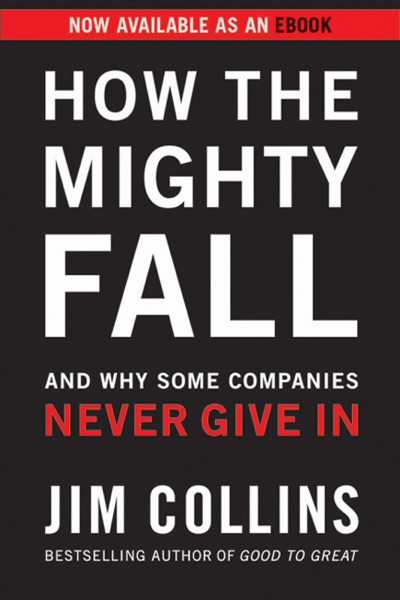
How the Mighty Fall
by Jim Collins
📖 About the book
How the Mighty Fall by Jim Collins, published in 2009, is a sobering look at the decline of once-great companies. Collins provides a roadmap for detecting the early signs of organizational decay, arguing that even the most successful firms are vulnerable if they lose their discipline. By analyzing the life cycles of companies that fell from grace, this book serves as a critical warning and a diagnostic tool for leaders who want to ensure their organizations remain healthy and resilient in the face of success and arrogance.
The book outlines the Five Stages of Decline: Hubris Born of Success, Undisciplined Pursuit of More, Denial of Risk and Peril, Grasping for Salvation, and Capitulation to Irrelevance or Death. Collins explains how success can lead to Strategic Hubris, where leaders begin to believe they are infallible and neglect the core values that made them great. He emphasizes the danger of "silver bullet" solutions—hiring a superstar CEO or making a massive acquisition—instead of returning to the disciplined management and core competencies that originally drove their success.
Essential for executives and board members of established firms, this book provides a framework for self-assessment. Readers gain value by learning to recognize Early Warning Signals of decline before they become catastrophic. Real-world applications include conducting "pre-mortems" on major decisions and institutionalizing a culture of healthy skepticism and rigorous debate. By understanding how the mighty fall, leaders can develop a Productive Paranoia that guards against complacency and ensures their organization remains focused on its mission and core strengths for the long term.
💡 Key takeaways
Monitor your organization for Hubris Born of Success, ensuring that past triumphs do not lead to arrogance or a neglect of core operating disciplines.
Avoid the Undisciplined Pursuit of More by staying focused on areas where you can maintain excellence rather than overextending into markets you don't understand.
Recognize Denial of Risk and Peril early by encouraging internal debate and facing hard truths about market shifts before the company enters a death spiral.
❓ FAQ
Is "How the Mighty Fall" by Jim Collins free to download?
Yes. BookHubs provides a free preview for "How the Mighty Fall". For the full legal text we link to OpenLibrary (Internet Archive), which is also free to read.
What is "How the Mighty Fall" about?
Download How the Mighty Fall for free. Learn to detect the five stages of decline in once-great companies and how to reverse the downward spiral.
How long does it take to read "How the Mighty Fall"?
At an average reading pace of ~250 words per minute, "How the Mighty Fall" (240 pages) takes roughly 360 minutes — about 6.0 hours. The 3 key takeaways on this page cover the core ideas in under 5 minutes.
What is the ISBN of "How the Mighty Fall"?
The ISBN of "How the Mighty Fall" by Jim Collins is 978-0977324125, published by HarperBusiness.
📚 Related books
All books →
7 Habits of Highly Effective People
Stephen Covey

High Output Management
Andrew Grove

The Righteous Mind
Jonathan Haidt

Antifragile
Nassim Taleb

Business Model Generation
Osterwalder, Pigneur

Management
Peter Drucker