Good Strategy Bad Strategy
📖 About the book
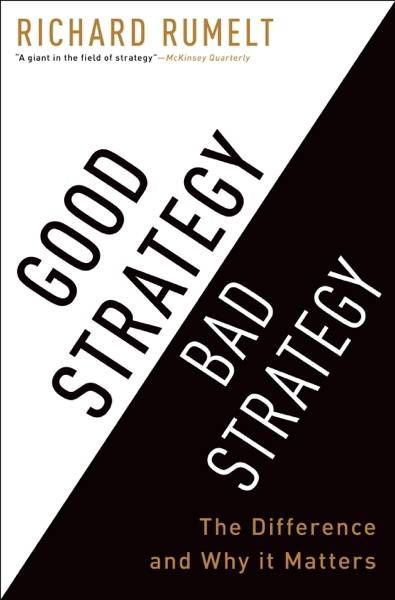
Good Strategy Bad Strategy by Richard Rumelt, published in 2011, is a critically acclaimed work that strips away the jargon and "fluff" surrounding modern management. Rumelt, a world-leading authority on strategy, argues that most of what is called "strategy" today is actually just a set of ambitious goals or motivational slogans. He provides a rigorous, clear-eyed framework for developing a Kernel of Good Strategy that actually solves problems and creates a coherent path forward for an organization facing competition and challenges.
The core of Rumelt's methodology is the "Kernel," which consists of three elements: a Diagnosis of the challenge, a Guiding Policy for dealing with that challenge, and a set of Coherent Actions designed to carry out the policy. He contrasts this with "Bad Strategy," which he identifies as a failure to face the problem, mistaking goals for strategy, and using "strategic fluff" to mask a lack of focus. Rumelt emphasizes the importance of Proximate Objectives—goals that are close enough at hand to be feasible—and the power of focusing resources on a single, decisive leverage point.
This book is essential reading for CEOs, consultants, and political leaders. Readers gain value by learning how to identify the "critical challenge" in any situation and how to develop a focused plan of action. Real-world applications include conducting Strategy Audits to remove vague mission statements and replacing them with actionable policies. By mastering Rumelt’s principles, leaders can develop a strategy that is not just a wish list, but a powerful tool for overcoming obstacles and achieving a sustainable competitive advantage through disciplined focus.
💡 Key takeaways
Construct a Kernel of Good Strategy by providing a clear diagnosis of the challenge, a guiding policy for response, and a set of coherent, coordinated actions.
Distinguish strategy from Ambition and Fluff by ensuring that your plan addresses a specific, identified obstacle rather than just stating desired financial outcomes.
Focus your resources on Proximate Objectives—targets that are ambitious yet achievable—to build momentum and maintain organizational focus during complex transformations.
❓ FAQ
Is "Good Strategy Bad Strategy" by Richard Rumelt free to download?
Yes. BookHubs provides a free preview for "Good Strategy Bad Strategy". For the full legal text we link to OpenLibrary (Internet Archive), which is also free to read.
What is "Good Strategy Bad Strategy" about?
Download Richard Rumelt's definitive guide to strategy for free. Learn how to distinguish real strategy from 'fluff' and achieve focused action.
How long does it take to read "Good Strategy Bad Strategy"?
At an average reading pace of ~250 words per minute, "Good Strategy Bad Strategy" (336 pages) takes roughly 504 minutes — about 8.4 hours. The 3 key takeaways on this page cover the core ideas in under 5 minutes.
What is the ISBN of "Good Strategy Bad Strategy"?
The ISBN of "Good Strategy Bad Strategy" by Richard Rumelt is 978-0307886231, published by Currency.
📚 Related books
All books →
7 Habits of Highly Effective People
Stephen Covey

High Output Management
Andrew Grove

The Righteous Mind
Jonathan Haidt

Antifragile
Nassim Taleb

Business Model Generation
Osterwalder, Pigneur

Management
Peter Drucker