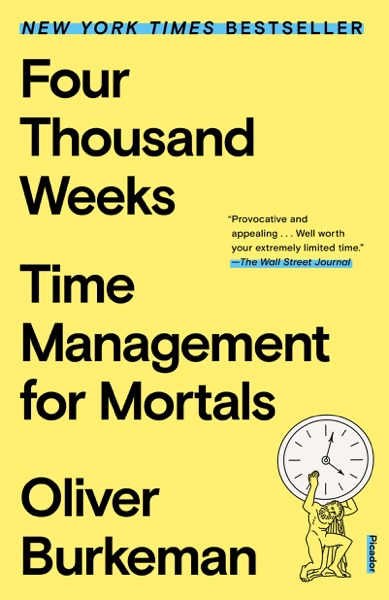
Four Thousand Weeks
📖 About the book
Four Thousand Weeks: Time Management for Mortals by Oliver Burkeman, published in 2021, is a philosophical and highly practical challenge to the 'Efficiency Trap.' Burkeman argues that our attempts to 'get everything done' only make us busier and more anxious. This work provides a rigorous framework for Radical Acceptance of our limitations, teaching leaders that true productivity comes not from speed, but from the ability to choose what to fail at and what to focus on in our limited four thousand weeks of life.
The core methodology revolves around the concept of Finitude. Burkeman explains why 'Clearing the Decks' is a myth and introduces the 'Efficiency Paradox'—the more efficient you are, the more work you attract. He details the importance of Strategic Procrastination and provides techniques for 'Do-Nothing Meditation' to build mental resilience. The focus is on moving from 'Time-Optimization' toward Meaningful Engagement, where strategic choices are guided by values and a realistic understanding of human capacity.
Essential reading for senior executives, creative leads, and anyone struggling with the 'Busy-ness' of modern life. Readers gain value by learning how to let go of impossible standards and how to build Sustained Focus on their most important projects. Practical applications include utilizing the 'Two-List Technique' for prioritization and redesigning Organizational Expectations to favor quality over quantity. By mastering Burkeman’s insights, leaders can build cultures that are more sane, stable, and ultimately more effective at delivering high-impact long-term results.
💡 Key takeaways
Embrace Radical Finitude by accepting that you will never get 'everything' done, allowing you to make more courageous and clear strategic choices about which tasks to prioritize.
Practice Strategic Procrastination by intentionally neglecting low-value tasks to protect the time and energy needed for your organization's truly vital strategic initiatives.
Avoid the Efficiency Trap by recognizing that becoming faster at processing inputs only leads to more inputs, and instead focus on the quality of your most significant contributions.
❓ FAQ
Is "Four Thousand Weeks" by Oliver Burkeman free to download?
Yes. BookHubs provides a free preview for "Four Thousand Weeks". For the full legal text we link to OpenLibrary (Internet Archive), which is also free to read.
What is "Four Thousand Weeks" about?
Free download of the guide to time management for mortals. Learn how to embrace your limits to lead a more meaningful and effective life with Oliver Burkeman.
How long does it take to read "Four Thousand Weeks"?
At an average reading pace of ~250 words per minute, "Four Thousand Weeks" (288 pages) takes roughly 432 minutes — about 7.2 hours. The 3 key takeaways on this page cover the core ideas in under 5 minutes.
What is the ISBN of "Four Thousand Weeks"?
The ISBN of "Four Thousand Weeks" by Oliver Burkeman is 978-0374159122, published by Farrar, Straus and Giroux.
📚 Related books
All books →
Atomic Habits
James Clear

Can't Hurt Me
David Goggins

Ego Is the Enemy
Ryan Holiday

Influence
Robert Cialdini

Man's Search for Meaning
Viktor Frankl

Never Split the Difference
Chris Voss