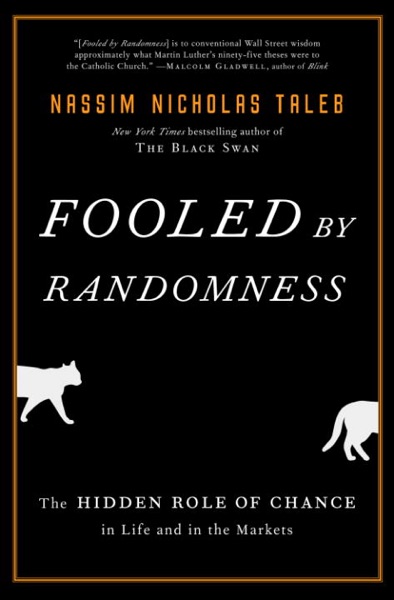
Fooled by Randomness
by Nassim Taleb
📖 About the book
Fooled by Randomness: The Hidden Role of Chance in Life and in the Markets by Nassim Taleb, published in 2001, is a provocative study of Luck and Probability. Taleb, a mathematical trader, argues that humans are biologically wired to see patterns where only randomness exists, leading them to mistake 'Lucky Fools' for strategic geniuses. This work provides a rigorous framework for Statistical Humility, teaching leaders how to distinguish between skill and noise in a world governed by nonlinear dynamics and fat-tailed distributions.
The core methodology centers on the Monte Carlo Simulator mindset and the rejection of 'Historical Narrative.' Taleb explains the importance of Ergodicity and details the role of 'Asymmetric Information.' He introduces the concept of the Rare Event (Black Swan) and provides strategies for 'Living with Randomness.' The focus is on moving from 'Over-confidence' toward Skepticism-Based Decision Making, where the leader evaluates their success based on the quality of their process rather than their short-term outcomes.
Essential reading for traders, risk officers, and CEOs in data-intensive industries. Readers gain value by learning how to eliminate the Hindsight Bias that sabotages organizational learning. Practical applications include utilizing Negative Evidence to stress-test strategies and redesigning Performance Compensation to filter out the impact of pure luck. By internalizing Taleb’s logic, leaders can build organizations that are structurally more robust and less susceptible to the devastating 'tail risks' that destroy more arrogant competitors.
💡 Key takeaways
Practice Statistical Humility by recognizing that a high percentage of your organization's short-term success may be the result of luck rather than unique strategic brilliance.
Utilize Scenario Modeling that accounts for 'Rare Events,' ensuring your organization has the resilience to survive market outliers that are statistically improbable but catastrophic.
Avoid Narrative Fallacy in your firm’s performance audits, focusing on the rigorous evaluation of your decision-making process rather than building 'just-so' stories about past results.