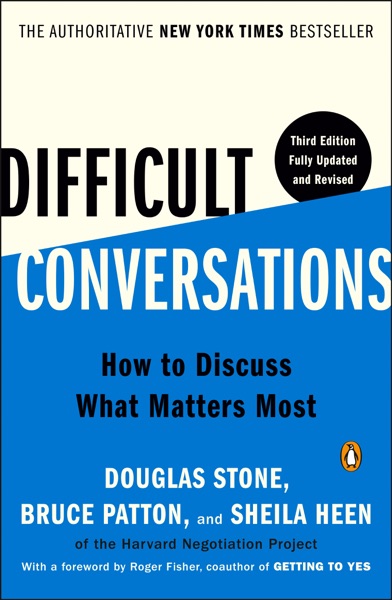
Difficult Conversations
📖 About the book
Difficult Conversations by Douglas Stone, Bruce Patton, and Sheila Heen, published in 1999, is a cornerstone work from the Harvard Negotiation Project. The authors argue that every tough talk is actually three conversations in one: the 'What Happened' conversation, the 'Feelings' conversation, and the 'Identity' conversation. This book provides a rigorous, Learning-Based Framework for navigating high-stakes interpersonal conflicts with clarity and poise, fundamentally changing how leaders approach disagreement.
The core methodology centers on the shift from 'Delivering a Message' to Managing a Dialogue. The authors explain how to stop the 'Blame Game' and move toward Joint Contribution by identifying the underlying assumptions and emotions that drive conflict. They introduce the concept of the Third Story—an objective perspective that includes both parties' views. The framework emphasizes the need to understand your own 'Identity Triggers' and provides techniques for listening from the inside out to find creative, win-win solutions.
Essential reading for negotiators, managers, and anyone in a collaborative environment. Readers gain value by learning how to de-escalate tension and turn adversarial encounters into productive problem-solving sessions. Real-world applications include utilizing the Three Conversations Model to resolve boardroom disputes and applying 'impact vs. intent' analysis to clear up misunderstandings. By mastering these techniques, leaders can handle even the most sensitive topics with confidence, ensuring organizational alignment and psychological health.
💡 Key takeaways
Analyze every conflict through the Three Conversations framework—What Happened, Feelings, and Identity—to identify the root causes of disagreement beyond surface-level issues.
Shift your mindset from Certainty to Curiosity, focusing on understanding the other person’s perspective and contribution rather than proving you are right.
Use the Third Story technique to initiate difficult talks, framing the situation from an objective viewpoint that acknowledges both parties' valid concerns and goals.
❓ FAQ
Is "Difficult Conversations" by Stone, Patton, Heen free to download?
Yes. BookHubs provides a free preview for "Difficult Conversations". For the full legal text we link to OpenLibrary (Internet Archive), which is also free to read.
What is "Difficult Conversations" about?
Free download of the Harvard Negotiation Project classic. Learn how to handle tough talks with confidence and achieve collaborative solutions.
How long does it take to read "Difficult Conversations"?
At an average reading pace of ~250 words per minute, "Difficult Conversations" (250 pages) takes roughly 375 minutes — about 6.3 hours. The 3 key takeaways on this page cover the core ideas in under 5 minutes.
What is the ISBN of "Difficult Conversations"?
The ISBN of "Difficult Conversations" by Stone, Patton, Heen is 978-0140288520, published by Penguin Books.
📚 Related books
All books →
The 21 Irrefutable Laws of Leadership
John Maxwell

Dare to Lead
Brené Brown

How to Win Friends and Influence People
Dale Carnegie

Shoe Dog
Phil Knight

The Laws of Human Nature
Robert Greene

Think Again
Adam Grant