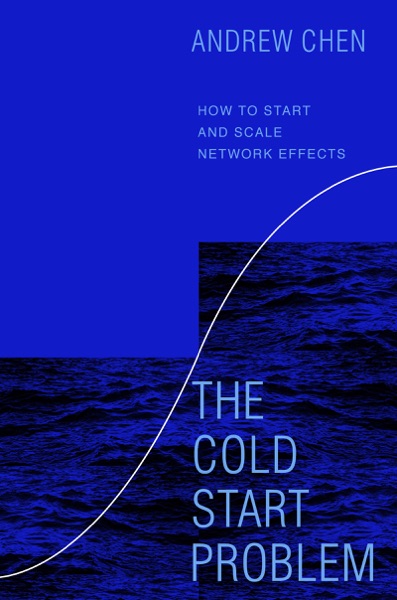
The Cold Start Problem
by Andrew Chen
📖 About the book
The Cold Start Problem: How to Start and Scale Network Effects by Andrew Chen, published in 2021, is a rigorous exploration of the Economics of Platforms. Chen, a general partner at Andreessen Horowitz, argues that the hardest part of building a network is the beginning—the 'Cold Start.' This work provides a framework for Atomic Network Design, teaching leaders how to find the minimum number of users required to make a network self-sustaining and how to navigate the 'Hard Side' of the market.
The core methodology centers on the Stages of the Network Effect: The Cold Start, The Tipping Point, Escape Velocity, The Ceiling, and The Moat. Chen explains the importance of 'Subsidizing the Hard Side' (e.g., drivers for Uber, hosts for Airbnb) and provides techniques for Viral Growth Loops. He introduces the concept of the Anti-Network Effect and details how to manage 'Network Collapse.' The focus is on moving from 'Standard User Acquisition' toward Structural Viral Scaling.
This is mandatory reading for product managers in SaaS, social media, and marketplaces. Readers gain concrete value by learning how to identify their Atomic Network. Practical applications include utilizing 'Invite-Only' launches to manage quality and implementing Engagement-Based Retention models. By internalizing Chen’s insights, leaders can build organizations that leverage network dynamics to achieve exponential growth and unshakeable market dominance.
💡 Key takeaways
Identify your Atomic Network—the smallest possible scale where your network can provide enough value to be self-sustaining—and focus all organizational energy on dominating that tiny niche first.
Identify and subsidize the Hard Side of the Network, recognizing that the group that is hardest to attract (e.g., content creators or high-value sellers) is the primary driver of the platform's strategic value.
Prepare for the Network Ceiling, recognizing that as your organization scales, the very effects that drove growth (like openness) can lead to 'Network Fatigue' and systemic value degradation.
❓ FAQ
Is "The Cold Start Problem" by Andrew Chen free to download?
Yes. BookHubs provides a free preview for "The Cold Start Problem". For the full legal text we link to OpenLibrary (Internet Archive), which is also free to read.
What is "The Cold Start Problem" about?
Free download of the guide to Network Effects. Learn Andrew Chen's framework for launching and scaling marketplaces and social platforms.
How long does it take to read "The Cold Start Problem"?
At an average reading pace of ~250 words per minute, "The Cold Start Problem" (400 pages) takes roughly 600 minutes — about 10.0 hours. The 3 key takeaways on this page cover the core ideas in under 5 minutes.
What is the ISBN of "The Cold Start Problem"?
The ISBN of "The Cold Start Problem" by Andrew Chen is 978-0062969071, published by HarperBusiness.
📚 Related books
All books →
The Hard Thing About Hard Things
Ben Horowitz

The Mom Test
Rob Fitzpatrick

Inspired
Marty Cagan

The Everything Store
Brad Stone

The Lean Startup
Eric Ries

The Snowball
Alice Schroeder