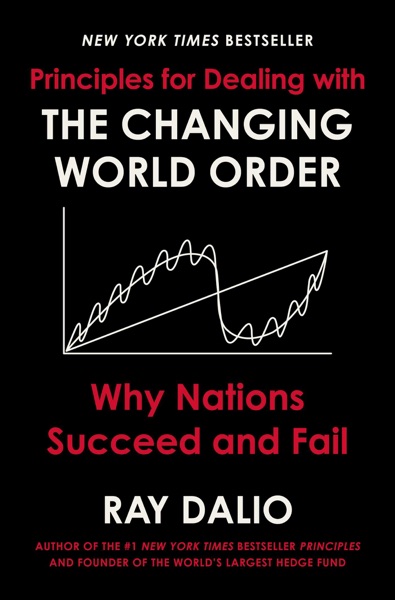
Principles for Dealing with the Changing World Order
by Ray Dalio
📖 About the book
Principles for Dealing with the Changing World Order: Why Nations Succeed and Fail by Ray Dalio, published in 2021, is a rigorous study of Macro-Economic and Geopolitical Cycles. Dalio argues that history follows a 'Big Cycle'—a predictable pattern of rise, peak, and decline for every empire and reserve currency. This book provides a framework for leaders to understand the Five Great Forces: debt/capital cycles, internal order/disorder, external order/disorder, acts of nature, and human inventiveness.
The methodology centers on the Big Cycle Scorecard used to evaluate the relative strength of countries like the US and China. Dalio explains the importance of Historical Analogies and provide techniques for 'Portfolio Diversification across Jurisdictions.' He introduces the concept of the Wealth Gap Paradox and details the role of 'Productivity and Education' as leading indicators of long-term dominance. The focus is on moving from 'Short-Term Forecasting' toward Generational Strategic Planning based on deep data and cyclical analysis.
This is crucial reading for global CEOs, policy makers, and large-scale investors. Readers gain value by learning how to anticipate Systemic Disruptions before they occur. Practical applications include utilizing 'Conflict Analysis' for supply chain planning and implementing Global Risk Management frameworks. By mastering Dalio’s insights, leaders can ensure their organizations are positioned to survive and thrive during the inevitable transitions of the global order.
💡 Key takeaways
Utilize the Big Cycle Scorecard to assess the long-term health and stability of the markets and jurisdictions where your organization operates.
Understand the Debt and Capital Cycle to anticipate major shifts in interest rates and currency values, ensuring your organization’s balance sheet is hedged against systemic shocks.
Prioritize Jurisdictional Diversification for your organization's assets and talent, recognizing that global geopolitical shifts can create extreme risks for firms concentrated in a single region.
❓ FAQ
Is "Principles for Dealing with the Changing World Order" by Ray Dalio free to download?
Yes. BookHubs provides a free preview for "Principles for Dealing with the Changing World Order". For the full legal text we link to OpenLibrary (Internet Archive), which is also free to read.
What is "Principles for Dealing with the Changing World Order" about?
Free download of Ray Dalio's guide to global cycles. Learn how to navigate the shifting geopolitical and economic landscape using historical patterns.
How long does it take to read "Principles for Dealing with the Changing World Order"?
At an average reading pace of ~250 words per minute, "Principles for Dealing with the Changing World Order" (576 pages) takes roughly 864 minutes — about 14.4 hours. The 3 key takeaways on this page cover the core ideas in under 5 minutes.
What is the ISBN of "Principles for Dealing with the Changing World Order"?
The ISBN of "Principles for Dealing with the Changing World Order" by Ray Dalio is 978-1982160272, published by Avid Reader Press.
📚 Related books
All books →
The 21 Irrefutable Laws of Leadership
John Maxwell

Dare to Lead
Brené Brown

How to Win Friends and Influence People
Dale Carnegie

Shoe Dog
Phil Knight

The Laws of Human Nature
Robert Greene

Think Again
Adam Grant