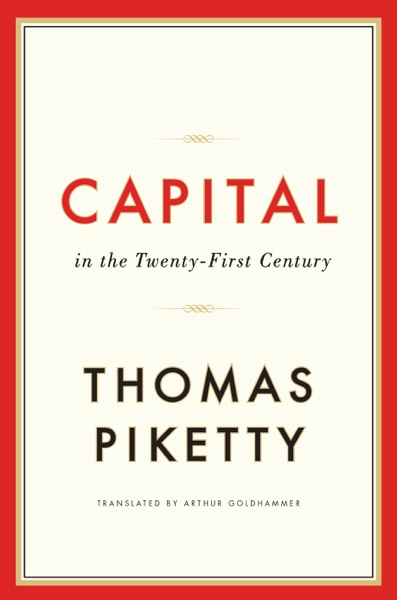
Capital in the Twenty-First Century
📖 About the book
Capital in the Twenty-First Century by Thomas Piketty, published in 2013, is a rigorous empirical study of Wealth and Income Inequality. Piketty argues that when the rate of return on capital (r) is greater than the rate of economic growth (g), wealth naturally concentrates in the hands of the elite. This book provides a framework for understanding Long-Term Capital Dynamics, using data from over three centuries to predict the future of global social and economic stability.
The core methodology centers on the r > g Formula and the analysis of 'Patrimonial Capitalism.' Piketty explains the importance of Progressive Taxation as a stabilizer and details the role of 'Inherited Wealth' in modern economies. He introduces the concept of the Capital/Income Ratio and provides strategies for managing 'Systemic Risk' in a globalized financial world. The focus is on moving from 'Optimistic Assumptions' toward Data-Driven Realism regarding distribution.
Mandatory reading for large-scale investors, social entrepreneurs, and CEOs of multi-national firms. Readers gain value by learning how to anticipate Social Instability driven by inequality. Practical applications include utilizing 'Global Wealth Data' for risk assessment and implementing Inclusive Corporate Governance. By internalizing Piketty’s logic, leaders can better navigate the political and economic shifts that define the 21st-century market landscape.
💡 Key takeaways
Understand the r > g Dynamics, recognizing that in slow-growth environments, established capital will naturally outperform labor, leading to increased market concentration.
Monitor the Capital/Income Ratio in your operating jurisdictions, as high levels of wealth inequality are leading indicators of impending regulatory and political disruption.
Adopt a Long-Term Institutional Perspective on wealth, ensuring your organization’s strategy accounts for the shifting global consensus toward transparency and progressive fiscal policy.
❓ FAQ
Is "Capital in the Twenty-First Century" by Thomas Piketty free to download?
Yes. BookHubs provides a free preview for "Capital in the Twenty-First Century". For the full legal text we link to OpenLibrary (Internet Archive), which is also free to read.
What is "Capital in the Twenty-First Century" about?
Free download of Thomas Piketty's analysis of wealth inequality. Master the r > g formula and the future of global capital distribution.
How long does it take to read "Capital in the Twenty-First Century"?
At an average reading pace of ~250 words per minute, "Capital in the Twenty-First Century" (696 pages) takes roughly 1044 minutes — about 17.4 hours. The 3 key takeaways on this page cover the core ideas in under 5 minutes.
What is the ISBN of "Capital in the Twenty-First Century"?
The ISBN of "Capital in the Twenty-First Century" by Thomas Piketty is 978-0674430006, published by Belknap Press.
📚 Related books
All books →
Margin of Safety
Seth Klarman

Misbehaving
Richard H. Thaler

Poor Charlie's Almanack
Charlie Munger

The Big Short
Michael Lewis

The Intelligent Investor
Benjamin Graham

Think and Grow Rich
Napoleon Hill