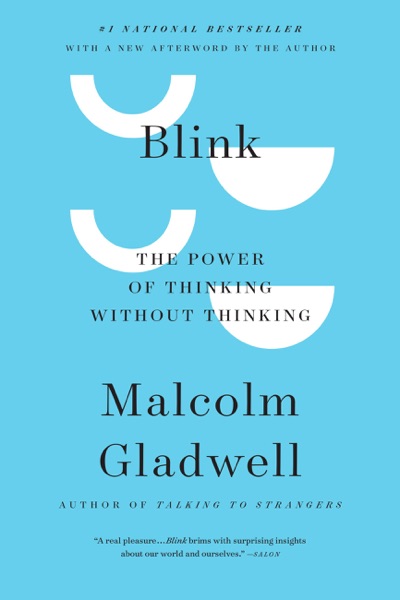
Blink
📖 About the book
Blink: The Power of Thinking Without Thinking by Malcolm Gladwell, published in 2005, explores the nature of rapid decision-making. Gladwell argues that snap judgments—decisions made in the first two seconds—are often as accurate as those made after months of analysis. This book provides a rigorous exploration of the Adaptive Unconscious, teaching leaders how to harness their intuitive expertise and when to be wary of the 'dark side' of instinct, such as implicit bias and stereotyping.
The core methodology centers on Thin-Slicing—the ability of our minds to find patterns based on very narrow slices of experience. Gladwell provides numerous case studies, from art experts detecting forgeries to firemen sensing danger, explaining how 'Training and Experience' refine our intuition. He introduces the concept of the Locked Door (the inability to explain why we feel a certain way) and warns about 'Analysis Paralysis.' The focus is on moving beyond Information Overload to trust the expertise-driven gut feelings that lead to rapid strategic breakthroughs.
This is mandatory reading for emergency responders, senior negotiators, and creative directors. Readers gain value by learning how to recognize when their instincts are being 'primed' or manipulated by their environment. Practical applications include utilizing Rapid Prototyping to test initial hunches and redesigning Hiring Interviews to minimize snap-judgment bias. By mastering the science of 'Blink,' leaders can make faster, more confident decisions in high-velocity markets where wait-and-see approaches lead to missed opportunities.
💡 Key takeaways
Cultivate Thin-Slicing Expertise within your team by providing the deep experience and feedback needed for their 'adaptive unconscious' to recognize accurate strategic patterns.
Avoid Information Overload during critical decision-making, recognizing that adding more data often leads to less accuracy and slower organizational response times.
Audit your Intuitive Biases by understanding how your environment 'primes' your snap judgments, ensuring that your quick decisions are based on data rather than unconscious stereotypes.
❓ FAQ
Is "Blink" by Malcolm Gladwell free to download?
Yes. BookHubs provides a free preview for "Blink". For the full legal text we link to OpenLibrary (Internet Archive), which is also free to read.
What is "Blink" about?
Free download of Gladwell's guide to snap judgments. Learn the power of 'thin-slicing' and how to master your adaptive unconscious in leadership.
How long does it take to read "Blink"?
At an average reading pace of ~250 words per minute, "Blink" (304 pages) takes roughly 456 minutes — about 7.6 hours. The 3 key takeaways on this page cover the core ideas in under 5 minutes.
What is the ISBN of "Blink"?
The ISBN of "Blink" by Malcolm Gladwell is 978-0316172325, published by Little, Brown and Company.
📚 Related books
All books →
Atomic Habits
James Clear

Can't Hurt Me
David Goggins

Ego Is the Enemy
Ryan Holiday

Influence
Robert Cialdini

Man's Search for Meaning
Viktor Frankl

Never Split the Difference
Chris Voss