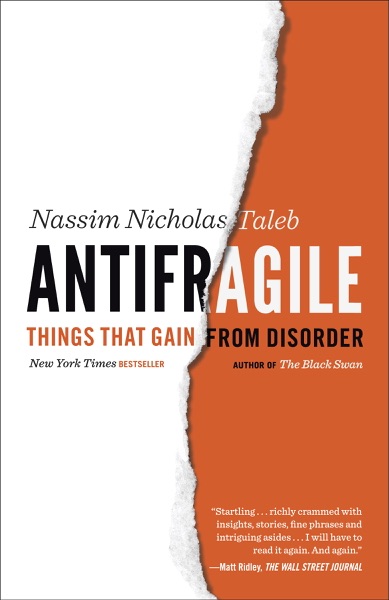
Antifragile
by Nassim Taleb
📖 About the book
Antifragile: Things That Gain from Disorder by Nassim Nicholas Taleb, published in 2012, is the definitive work on Resilience and Growth under Stress. Taleb argues that the opposite of 'fragile' is not 'robust' or 'resilient'—which merely resist shock—but Antifragile: systems that actually get stronger when subjected to volatility, chaos, and stressors. This book provides a rigorous framework for Risk Management and Innovation, teaching leaders how to position their organizations to benefit from the 'Black Swan' events that destroy their competitors.
The core methodology centers on the Triad: Fragile, Robust, and Antifragile. Taleb explains the concept of Skin in the Game and the importance of 'Via Negativa' (improvement through subtraction). He introduces the Barbell Strategy—balancing extreme conservatism with high-upside risk—and provides techniques for 'Convexity Analysis.' The focus is on moving from 'Prediction-Based Planning' toward Structural Positioning where the organization has more to gain than to lose from unpredictable change.
This is mandatory reading for strategic planners, entrepreneurs, and senior executives in volatile industries. Readers gain concrete value by learning how to identify Fragility Markers in their business models. Practical applications include utilizing 'Optionality' in contract design and implementing Trial and Error (Bricolage) as a primary innovation method. By internalizing Taleb’s logic, leaders can build organizations that are not just survivors of chaos, but the primary beneficiaries of a world that is inherently and irreversibly uncertain.
💡 Key takeaways
Achieve Organizational Antifragility by building systems that utilize small, frequent stressors—like market competition or internal debate—to drive continuous improvement and strength.
Utilize The Barbell Strategy in capital allocation, protecting 90% of your organization with extreme safety while investing 10% in high-upside 'Black Swan' bets.
Apply Via Negativa to your organizational processes, recognizing that the most effective way to increase robustness is often by removing sources of fragility and complexity.