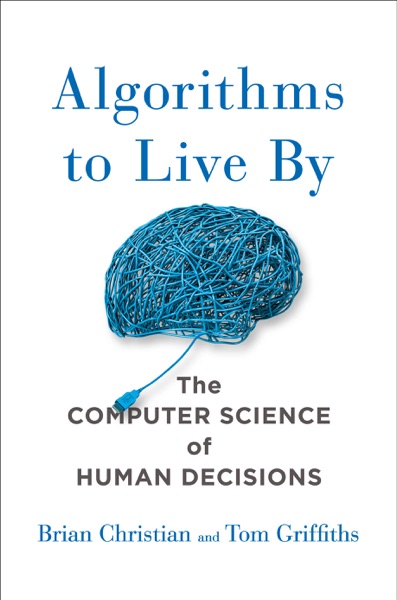
Algorithms to Live By
by Brian Christian, Tom Griffiths
📖 About the book
Algorithms to Live By: The Computer Science of Human Decisions by Brian Christian and Tom Griffiths, published in 2016, is a rigorous bridge between Computational Logic and Human Choice. The authors argue that most of our life's dilemmas—from when to stop searching to how to organize our time—have been mathematically solved by computer scientists. This book provides a framework for Algorithmic Efficiency, teaching leaders how to apply concepts like 'Explore/Exploit' and 'Sorting' to optimize their organizational processes and personal lives.
The methodology identifies key algorithms: Optimal Stopping (The 37% Rule), Caching (organizing space), and Scheduling. Christian and Griffiths explain the importance of Overfitting in decision-making and detail the role of Game Theory in human interaction. They introduce the concept of the Computational Kindness—designing systems that reduce the cognitive load for others—and provide strategies for 'Bounded Rationality.' The focus is on moving from 'Intuitive Guessing' toward Mathematically Sound Heuristics.
Essential reading for productivity-focused leaders and system designers. Readers gain concrete value by learning the Mathematics of Timing. Practical applications include utilizing the 'Interval-Timer Rule' for email management and implementing Optimal Search Protocols for hiring. By mastering these algorithms, leaders can eliminate 'analysis paralysis' and ensure their organization’s resources are allocated with the highest degree of logical precision.
💡 Key takeaways
Apply the 37% Rule (Optimal Stopping) to high-stakes decisions like hiring or procurement, recognizing the mathematical point where you should stop searching and commit to the best option found so far.
Balance Exploration and Exploitation within your firm's R&D, ensuring a constant cycle of trying new strategic paths while ruthlessly maximizing the value of established successes.
Practice Computational Kindness by structuring your communication and requests to minimize the mental effort required for your team to respond, increasing total organizational throughput.
❓ FAQ
Is "Algorithms to Live By" by Brian Christian, Tom Griffiths free to download?
Yes. BookHubs provides a free preview for "Algorithms to Live By". For the full legal text we link to OpenLibrary (Internet Archive), which is also free to read.
What is "Algorithms to Live By" about?
Free download of the guide to computer science for humans. Learn how to use algorithms like Optimal Stopping and Game Theory in daily life and business.
How long does it take to read "Algorithms to Live By"?
At an average reading pace of ~250 words per minute, "Algorithms to Live By" (368 pages) takes roughly 552 minutes — about 9.2 hours. The 3 key takeaways on this page cover the core ideas in under 5 minutes.
What is the ISBN of "Algorithms to Live By"?
The ISBN of "Algorithms to Live By" by Brian Christian, Tom Griffiths is 978-1627790369, published by Henry Holt and Co..


