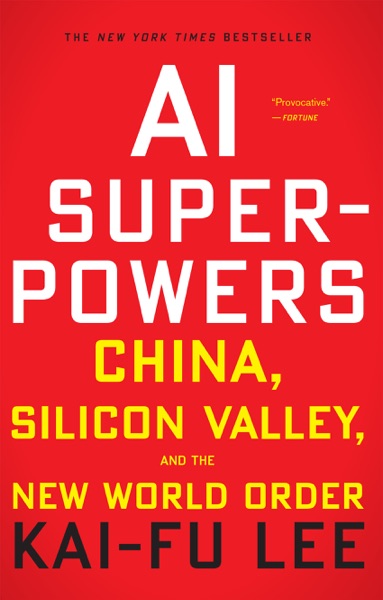
AI Superpowers
by Kai-Fu Lee
📖 About the book
AI Superpowers: China, Silicon Valley, and the New World Order by Kai-Fu Lee, published in 2018, provides a rigorous analysis of the Global AI Rivalry. Lee, a former executive at Google and Microsoft and a leader in China's tech ecosystem, argues that the age of AI 'discovery' is over, and we are now in the age of AI Implementation. This book provides a framework for understanding how massive data sets and 'Gladiator' work cultures in China are challenging the traditional dominance of Silicon Valley, fundamentally shifting the geopolitical landscape.
The core methodology identifies Four Waves of AI: Internet AI, Business AI, Perception AI, and Autonomous AI. Lee explains the importance of Data as the New Oil and details why the 'Copycat' phase of Chinese tech led to a superior era of 'Deep Implementation.' He introduces the concept of the Human-AI Symbiosis and provides strategies for managing 'Mass Unemployment' through empathy-based social contracts. The focus is on moving from 'Technical Competition' toward Societal Rebalancing.
Essential reading for corporate strategists, international business students, and tech entrepreneurs. Readers gain value by learning the Execution Playbook of Chinese startups. Practical applications include utilizing 'High-Frequency Data Loops' and redesigning Supply Chains to account for Perception AI. By internalizing Lee’s insights, leaders can better navigate the complex trade-offs between US and Chinese technological models, ensuring their organizations are prepared for a dual-superpower world.
💡 Key takeaways
Shift from Discovery to Implementation in your AI strategy, recognizing that the current competitive edge comes from the speed and scale of applying existing algorithms to massive data sets.
Understand the Chinese 'Gladiator' Entrepreneurial Model, applying its lessons of intense execution and data-driven iteration to your organization's internal innovation cycles.
Prioritize Human-Centric Roles that AI cannot easily duplicate—such as those requiring deep empathy and social complexity—to build a resilient and high-value future workforce.
❓ FAQ
Is "AI Superpowers" by Kai-Fu Lee free to download?
Yes. BookHubs provides a free preview for "AI Superpowers". For the full legal text we link to OpenLibrary (Internet Archive), which is also free to read.
What is "AI Superpowers" about?
Free download of Kai-Fu Lee's guide to the global AI race. Learn about the rivalry between China and the US and the future of deep learning and work.
How long does it take to read "AI Superpowers"?
At an average reading pace of ~250 words per minute, "AI Superpowers" (272 pages) takes roughly 408 minutes — about 6.8 hours. The 3 key takeaways on this page cover the core ideas in under 5 minutes.
What is the ISBN of "AI Superpowers"?
The ISBN of "AI Superpowers" by Kai-Fu Lee is 978-1328546395, published by Houghton Mifflin Harcourt.
📚 Related books
All books →
The Age of Spiritual Machines
Ray Kurzweil

Superintelligence: Paths, Dangers, Strategies
Nick Bostrom

The Singularity Is Nearer
Ray Kurzweil

Abundance
Peter Diamandis, Steven Kotler

Life 3.0
Max Tegmark

Life 3.0: Being Human in the Age of Artificial Intelligence
Max Tegmark