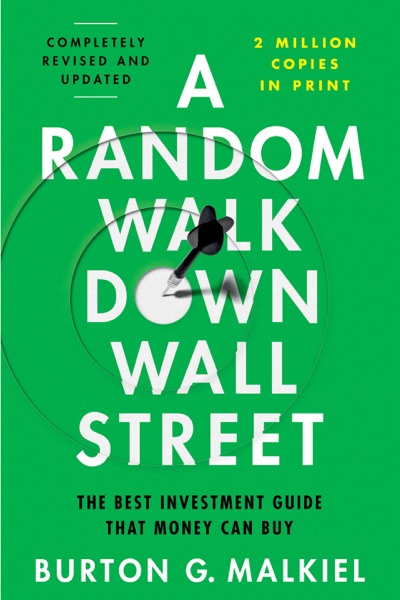
A Random Walk Down Wall Street
📖 About the book
A Random Walk Down Wall Street by Burton Malkiel, first published in 1973, is a foundational text for the Efficient Market Hypothesis (EMH). Malkiel argues that the stock market is so efficient at processing information that it is virtually impossible for an individual or professional manager to 'beat the market' consistently through stock picking or technical analysis. This book provides a rigorous, Data-Driven Framework for individuals to achieve financial success through low-cost, diversified, and passive investment strategies.
The core methodology centers on the Modern Portfolio Theory (MPT) and the 'Efficient Frontier.' Malkiel explains the difference between Firm-Foundation Theory (value) and Castle-in-the-Air Theory (psychological bubbles). He introduces the concept of the Lifecycle of Investing and provide strategies for 'Tax-Loss Harvesting.' The focus is on moving from 'Expensive Active Management' toward Broad-Based Indexing, where the investor captures the total growth of the economy with minimal fees and risk.
This is mandatory reading for anyone responsible for long-term capital preservation and pension fund management. Readers gain concrete value by learning how to avoid Financial Bubbles and 'Get-Rich-Quick' schemes. Practical applications include utilizing Total Stock Market Indexes for core holdings and implementing Periodic Rebalancing to maintain risk targets. By mastering Malkiel’s logic, leaders can build organizations and personal wealth plans that are structurally sound and statistically likely to out-perform 90% of actively managed alternatives over decades.
💡 Key takeaways
Adopt a Passive Indexing Strategy for your organization's long-term capital, recognizing that low-cost diversification is the most reliable way to capture market-level strategic growth.
Understand the Efficient Market Hypothesis to avoid wasting resources on trying to out-predict the stock market, focusing instead on variables you can control like costs and taxes.
Implement Lifecycle Asset Allocation, systematically adjusting your organization's risk profile as your strategic time horizons change to ensure liquidity and stability.
❓ FAQ
Is "A Random Walk Down Wall Street" by Burton Malkiel free to download?
Yes. BookHubs provides a free preview for "A Random Walk Down Wall Street". For the full legal text we link to OpenLibrary (Internet Archive), which is also free to read.
What is "A Random Walk Down Wall Street" about?
Free download of the classic on efficient markets. Learn why passive index investing out-performs active management with Burton Malkiel's proven research.
How long does it take to read "A Random Walk Down Wall Street"?
At an average reading pace of ~250 words per minute, "A Random Walk Down Wall Street" (448 pages) takes roughly 672 minutes — about 11.2 hours. The 3 key takeaways on this page cover the core ideas in under 5 minutes.
What is the ISBN of "A Random Walk Down Wall Street"?
The ISBN of "A Random Walk Down Wall Street" by Burton Malkiel is 978-0393358384, published by W. W. Norton & Company.
📚 Related books
All books →
Margin of Safety
Seth Klarman

Misbehaving
Richard H. Thaler

Poor Charlie's Almanack
Charlie Munger

The Big Short
Michael Lewis

The Intelligent Investor
Benjamin Graham

Think and Grow Rich
Napoleon Hill